

“Mashisoyo” as they say in South Korea – this is the word for ‘delicious’ that you’ll continually be using when you try Korean street food straight from the source.
South Korean street-food is some of the world’s best street food, which will keep you coming back for more (and more, and MORE…)
From oh so spicy dishes to decadent desserts and oodles of noodles, there is so much good food to try in South Korea.
This post may contain affiliate links to tours and hotels. These help us earn a small commission at no additional charge to you.

All of the street food we tried whilst in South Korea was generally inexpensive and readily available in multiple street food markets like Gwangjang Market, Dongmun Night Market (Jeju) or Myeongdong night market.
A foodie’s dream and suitable for all travel budgets, this is the best Korean street food to try in South Korea. Remember to leave your accommodation hungry as there are sooo many good foods to eat when travelling around South Korea.
This article was originally published on 5 February 2023.
You might like – Our first timers guide to Seoul including Korean SIM cards and eSIMs
South Korea checklist
We love using agoda.com, expedia.com and booking.com for researching and booking all our hotels, and Hostelworld for booking hostels.
For booking tours, transfers and SIM cards we recommend Get Your Guide, Viator, Trazy or Klook.
For booking rental cars visit Discover Cars. For private drivers and taxis, check out our Transfer guide >
Check out our South Korea travel booking resources >
All set for South Korea? Do one final check with our Seoul first timers guide and our South Korea packing list
Korean street food you must try in South Korea
1. Bibimbap
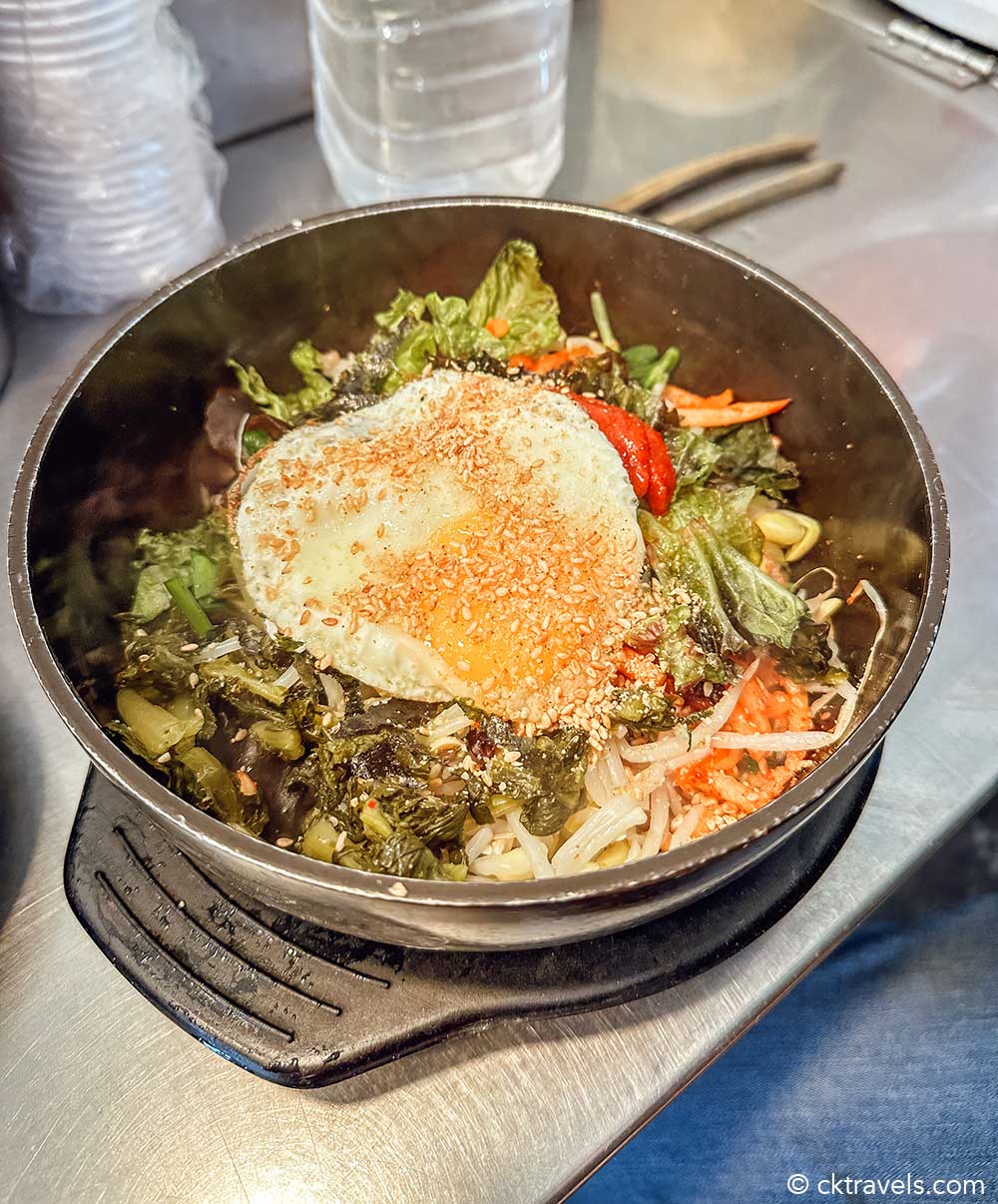
For us, bibimbap was one of the most delicious foods we tried during our time in South Korea.
A dish which means ‘mixed rice’, bibimbap is served in a bowl with rice or barley, plus vegetables, kimchi, gochujang sauce (Korean chili paste) and usually a fried egg on top (and sometimes with meat).
Bibimbap can be served cold or in a hot stone pot.

You might like – Our guide to Korean soju or Korean banana milk
2. Rice Cakes (Tteokbokki)
A South Korean foodie institution and a nice rice cake to boot, Tteok-bokki is incredibly popular either as a main dish or a side dish (and often served with eomuk – like a thin starchy fishcake).
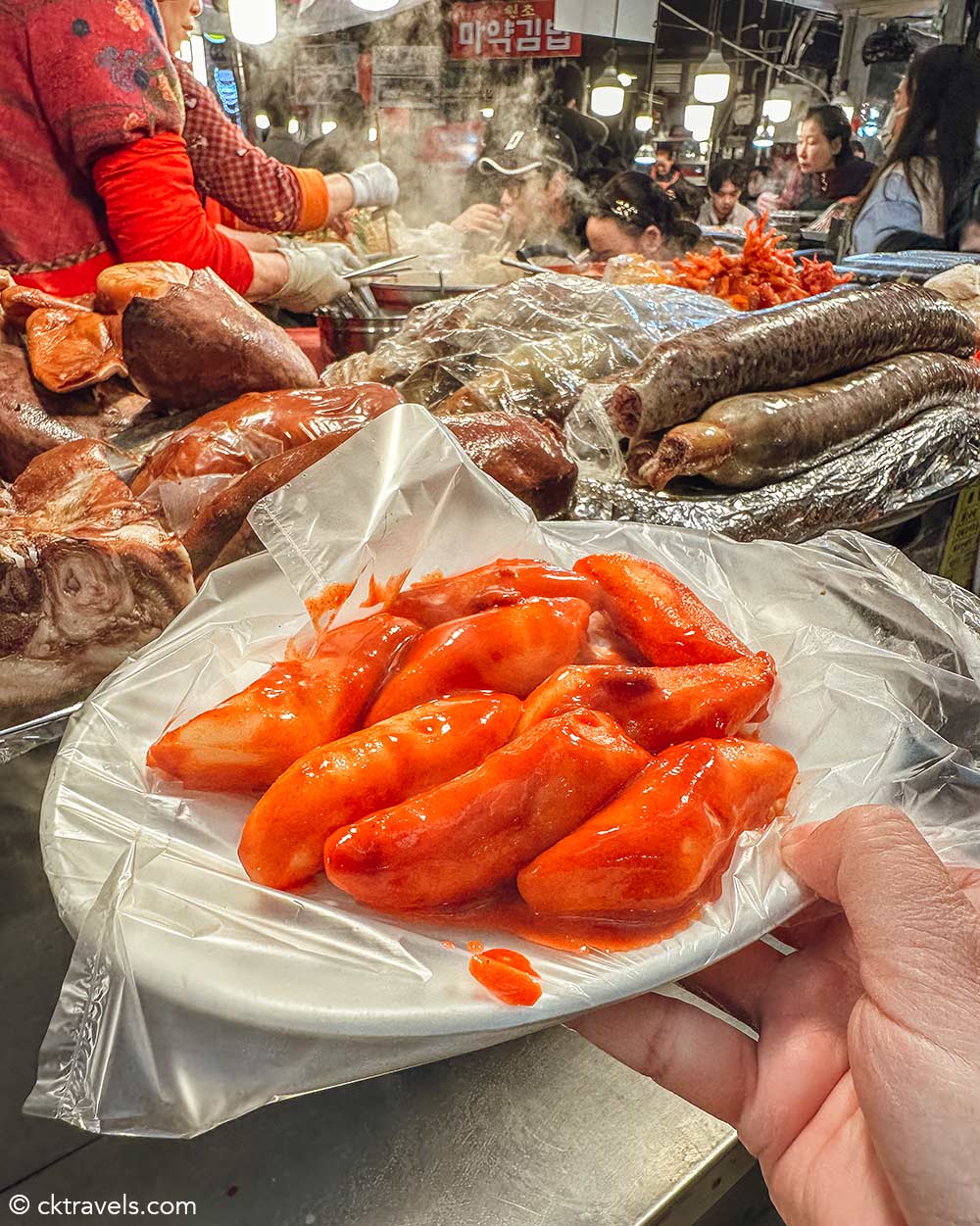
Served in bright red anchovy sauce (sweet AND spicy), tteok-bokki is a must try street food. We tried it on multiple occasions and some versions were a tad more thicker and gloopy than others.
We found our personal preference was the smaller Tteok-bokki ‘cakes’ as often, the larger ones are quite difficulty to chew, especially without a drink.
Join our Facebook South Korea Travel Planning and Tips Group!
Need help with your itinerary or have any South Korea related questions? Head on over to our friendly and active Facebook group with over 130,000 members!
Click here to join our group >
Or if you just want to see more of our South Korea photos, follow our South Korea Facebook page >
3. Korean Corn Dog
A very popular fast-food in South Korea (now widely exported), Korean Corn Dogs are a traditional hot dog sausage wrapped in panko bread crumbs and a cheese filling.
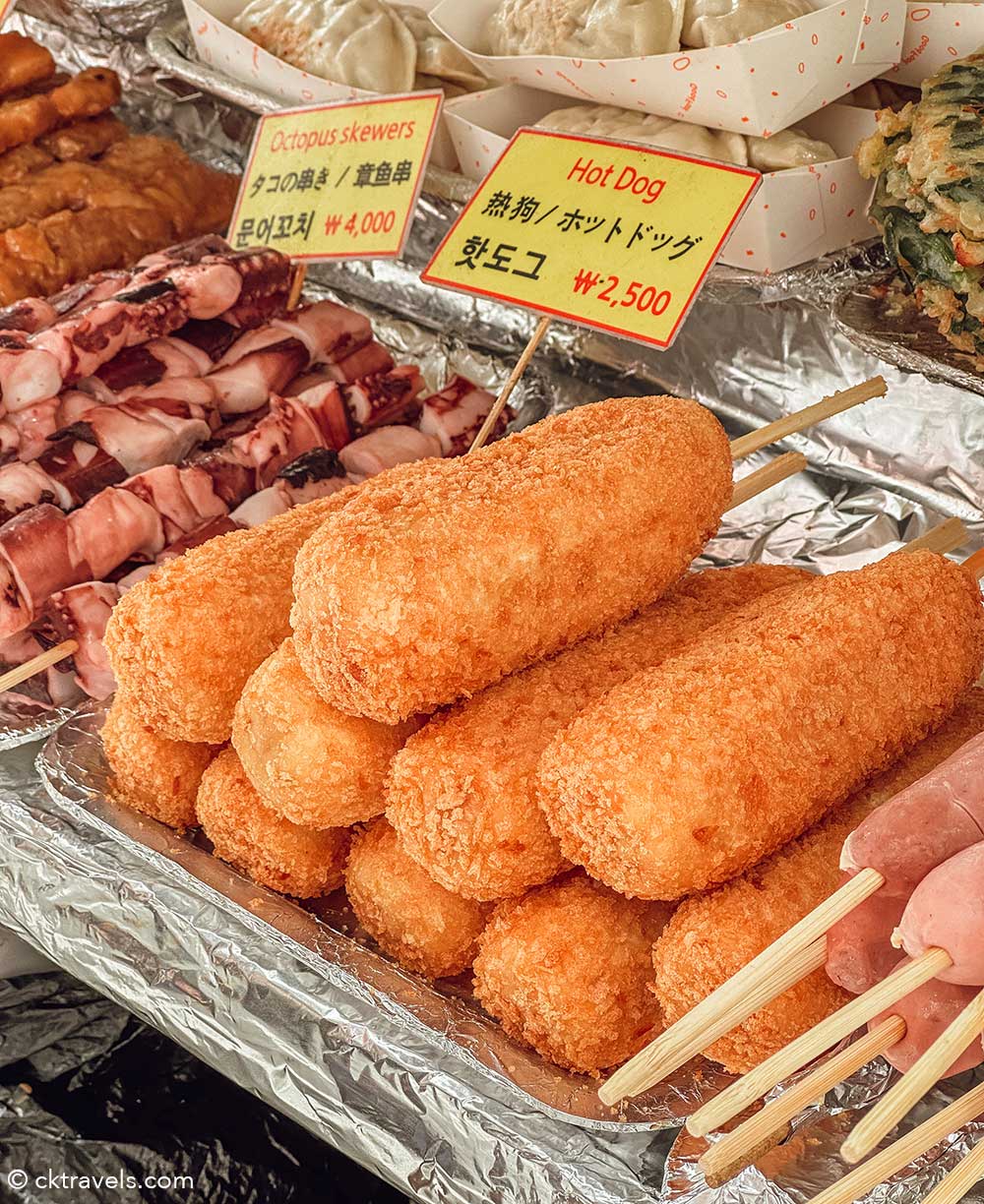
They are often served with mustard and tomato sauce (ketchup) but we’ve also seen versions where the sauce is already inside with the cheese.
One of our favourite things to do in Seoul is to go to a Korean baseball game and eat a hotdog with beer – you can’t beat it!
Check out these Seoul food tours with Klook including a kimchi & culture experience
4. Korean Sweet Pancake (Hotteok)
After leaving South Korea, we are still hungry for hotteoks. Possibly our favourite dessert whilst in South Korea, this is simply a sweet and sticky Korean dessert pancake that comes in a variety of flavours like honey, brown sugar or chocolate.
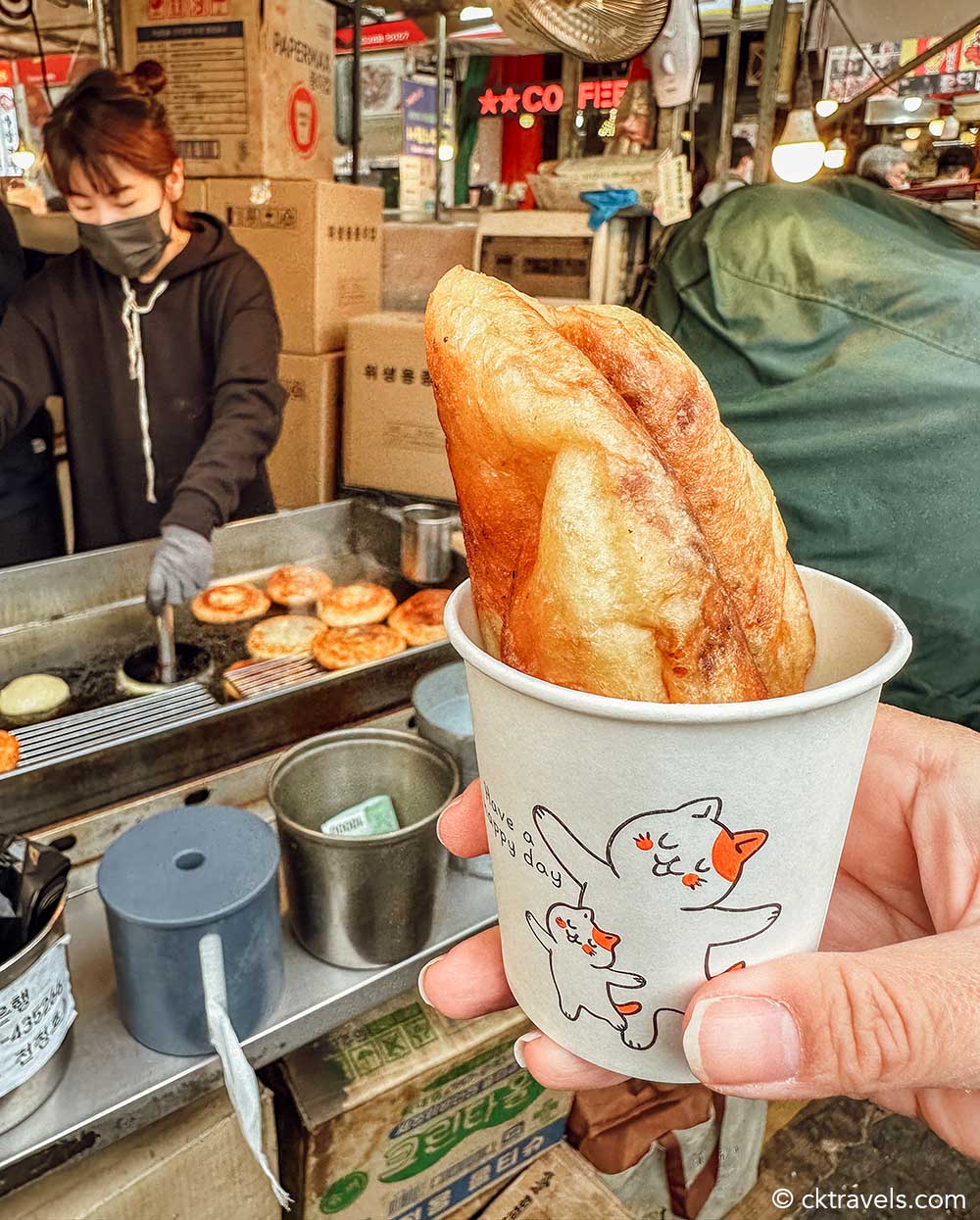
One of the best ever Korean hotteks we had was at Busan’s Ssiat Hotteok in BIFF Square.
The sticky sweet pancake contains crushed sunflower, pumpkin and sesame seeds, almonds and peanuts and is absolutely delicious and worthy of the big queues the stall gets.
You might like these Seoul neighbourhood guides:
Dongdaemun
Euljiro
Gangnam
Hannam-dong
Hongdae
Ikseon-dong
Insadong
Itaewon
Myeong-dong
Seongsu-dong
Sindang
Or check out our best neighbourhoods in Seoul Guide >
5. Fruit Hard Candy (Ddalgi Satang)
Whilst certainly not unique to Korea, this is super popular in many Asian night markets and particularly so in Korean night markets (although a little expensive compared to other street food so possibly aimed more at tourists).
Ddalgi satang are pieces of fruit such as grapes and strawberries which have been glazed with a sugar coating and skewered on a stick like a kebab. They are sweet and crunchy on the outside and soft and fruity in the inside.
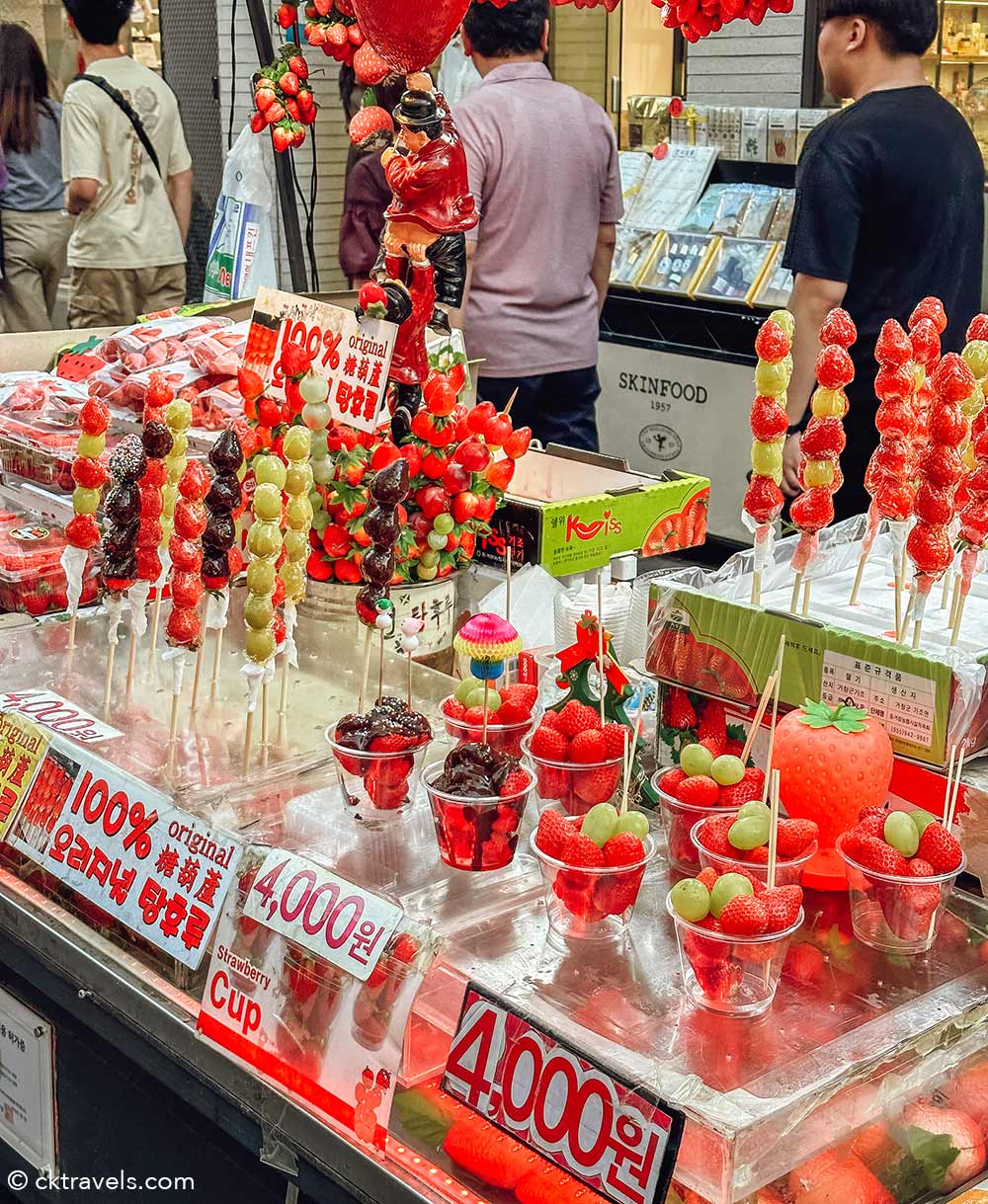
We also saw single strawberries on skewers blinged with sugar coating and all manner of treats like chocolate sprinkles, marshmallows and icing.
Other sugary and candied fruit is available like grapes are also available but strawberry seemed to be the most popular and the one that most street food vendors sold.
You might like – Our 3 day Seoul itinerary >
6 Knife-Cut Noodles (Gohyang Kalguksu)
There is something very hearty about home-made knife-cut noodles which are rolled, kneaded and then cut up in front of your very own eyes, before being added to a soupy broth. Sometimes served with vegetables and meat dumplings, devour them all whilst still hot.
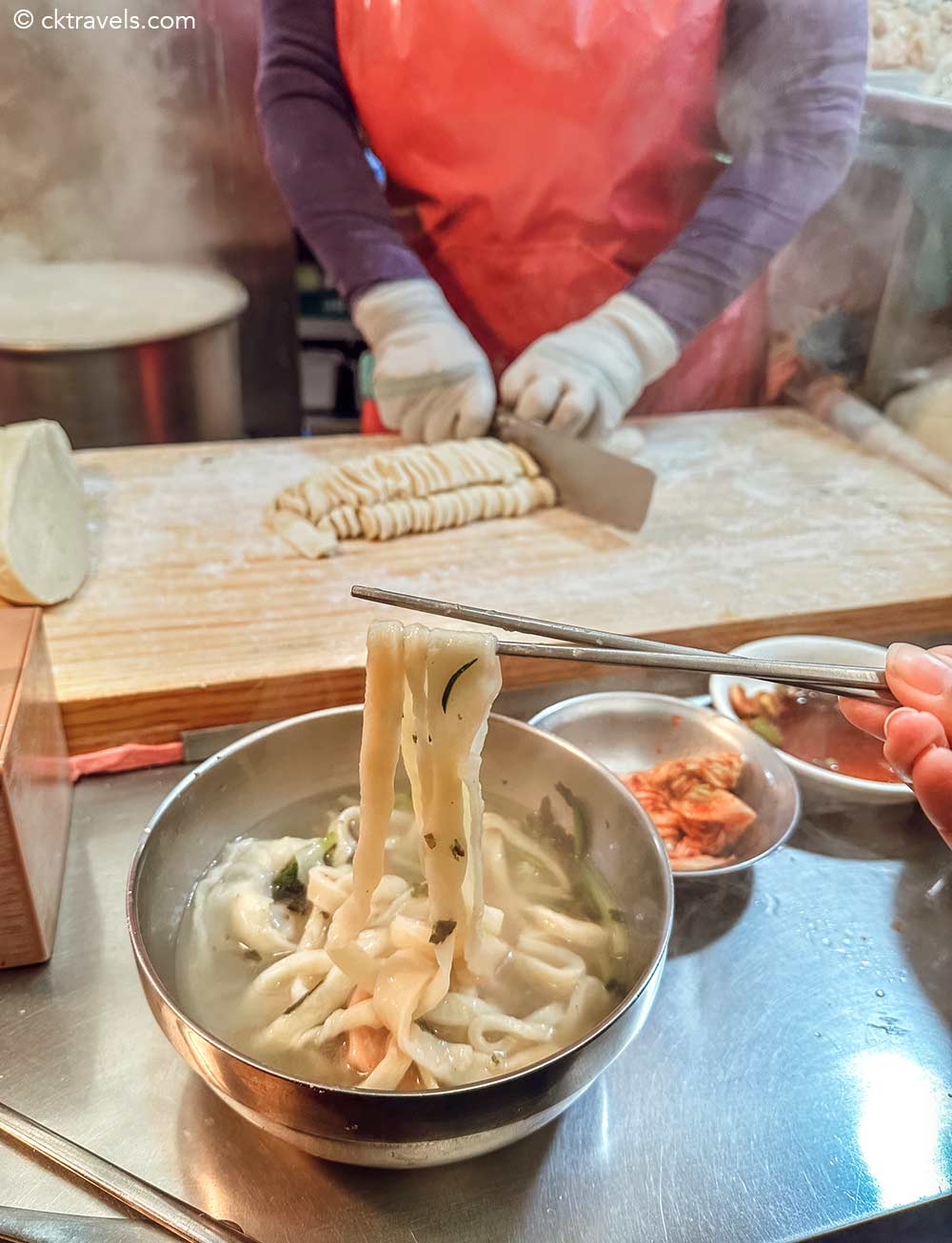
There has been a resurgence in the interest of gohyang kalguksu in recent years (especially in Seoul) in part thanks to them being featured on the Netflix series ‘Street Food: Asia’.
Expect to pay around 6,000 to 7,000 Korean Won for a dish of knife-cut noodles from a street food cart or night market in South Korea.
Two of the best markets to eat Kalguksu include Kalguksu Alley in Namdaemun Market and Gwangjang Market.
Read about the Netflix knife-cut noodle ladies stall at Gwangjang Market here >
You might like – Myeongdong Kyoja in Seoul – A Popular Kalguksu Restaurant >
7. Dumplings (Mandu)
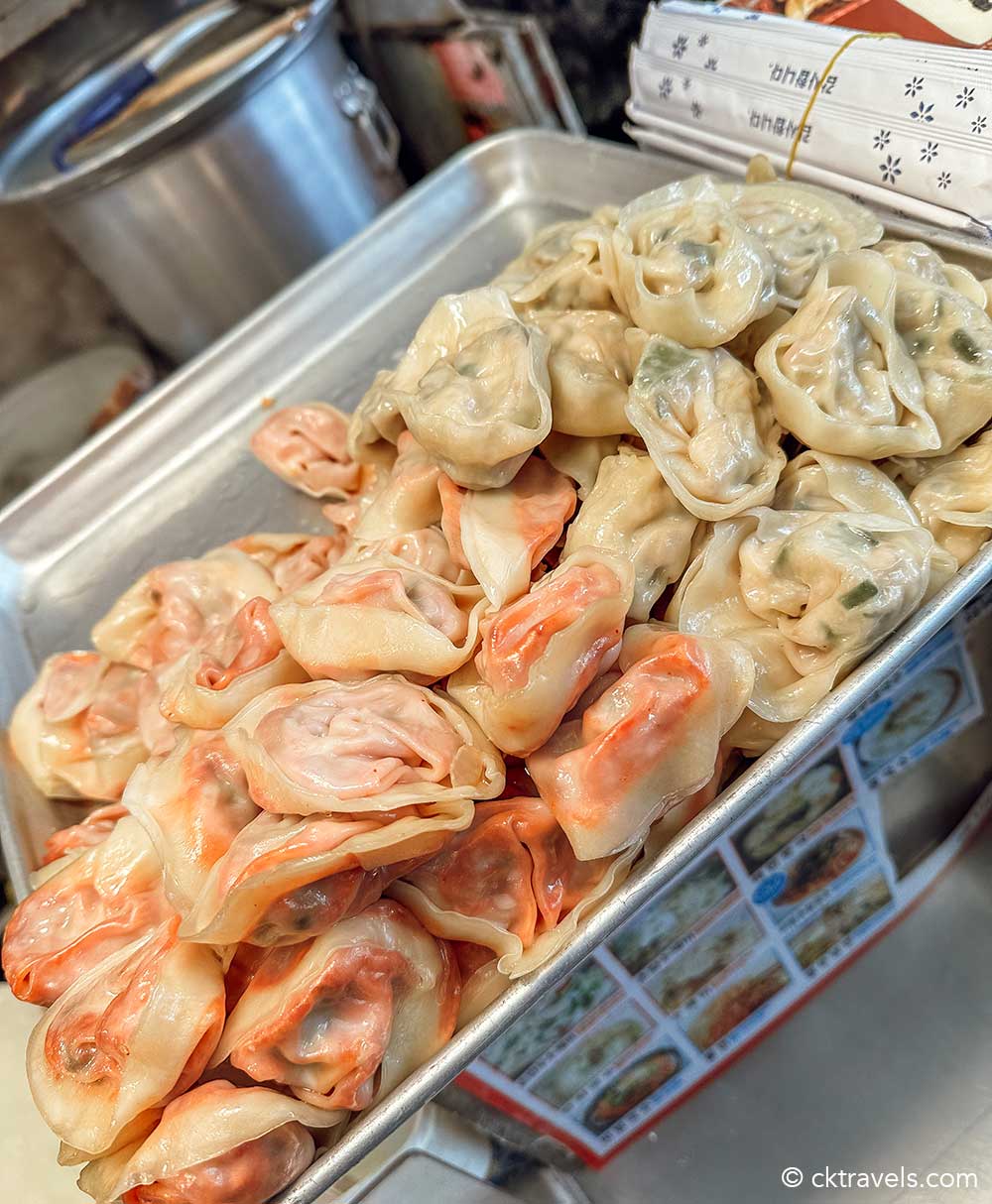
Mandu are Korean dumplings and widely available from street food stalls and night markets. You usually order them swimming in a noodle soup or served steamed just by themselves.
The two most common versions of mandu are usually kimchi (spicy cabbage) or minced pork.
You might like: Seoul: Korean Cooking Class at a Local Home and Market Tour >
8. Korean Fried Chicken (Dakgangjeong)
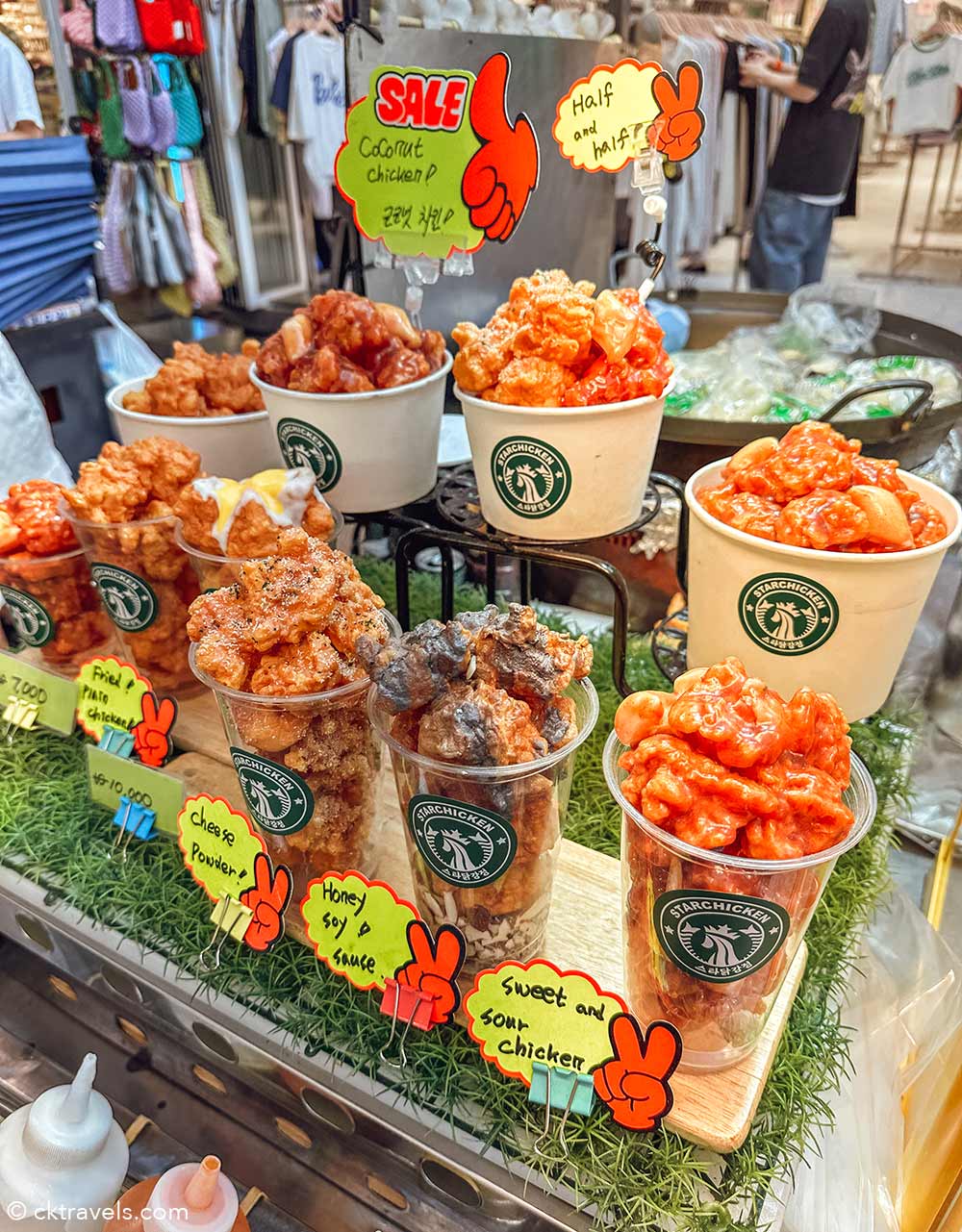
Sprinkle cuts of fine boneless chicken covered in a spicy and sweet sauce glaze with additional seasonings like cut up peanuts or sesame seed and et voila, you have Dakgangjeong.
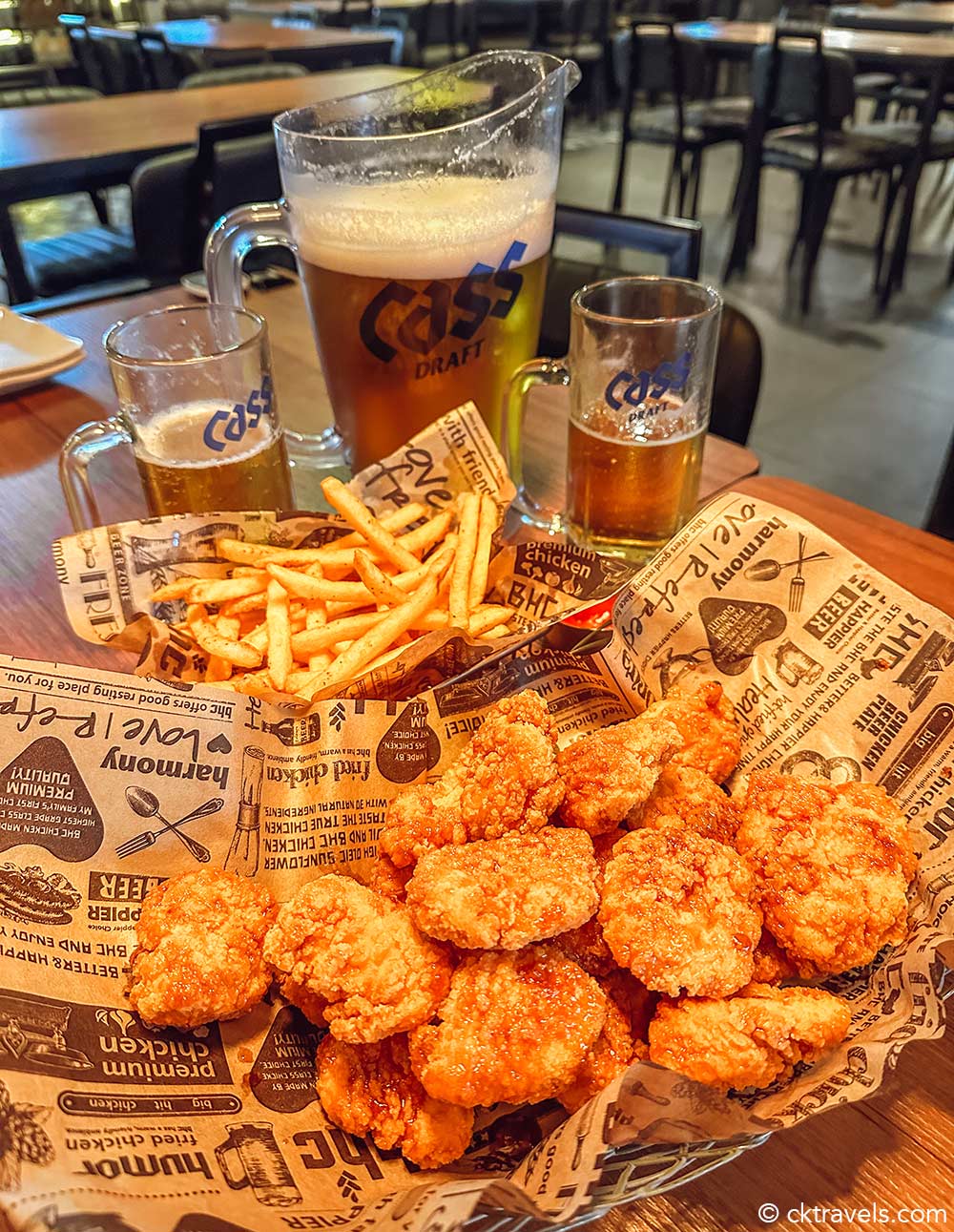
We had Dakgangjeong countless times in South Korea and it has to be one of our top 5 Korean street food dishes whilst there.
It can be bought from street food stalls but we’d recommend trying Dakgangjeong / Korean fried chicken with a nice pint of cold Korean beer (like Cass) in a fried chicken pub.
You might like: The best craft beer bars in Seoul >
You might like – Kalguksu Alley in Namdaemun Market Seoul Guide >
9. Mung Bean Pancake (Bindaetteok)
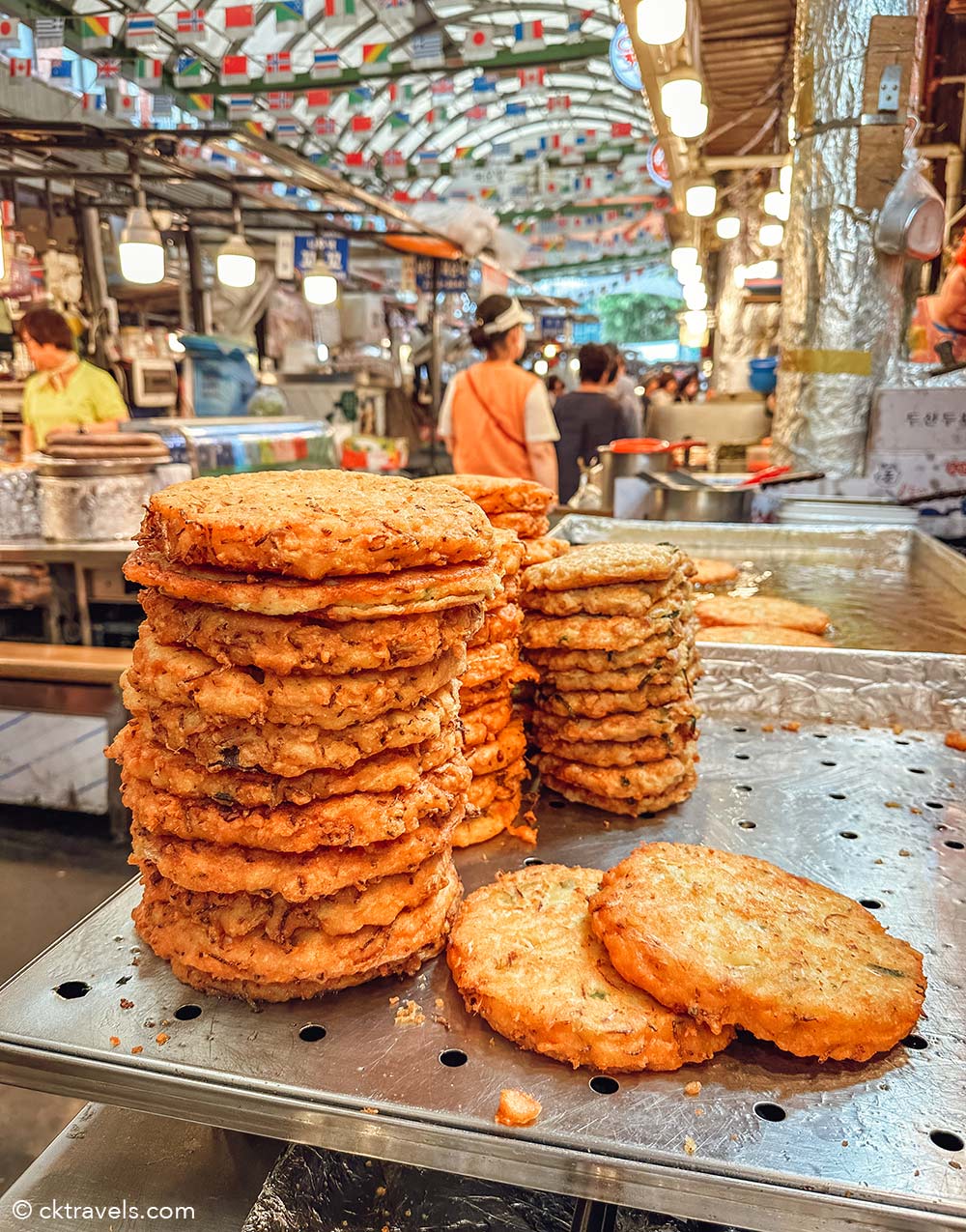
Hear that crunching noise whilst at a night market in South Korea?! That’ll be the Bindaetteok (mung bean pancakes) being prepared! Witness grinding mills and wheels crushing up mung beans, ready to be dropped into a batter mix, usually with kimchi and some serious spices.
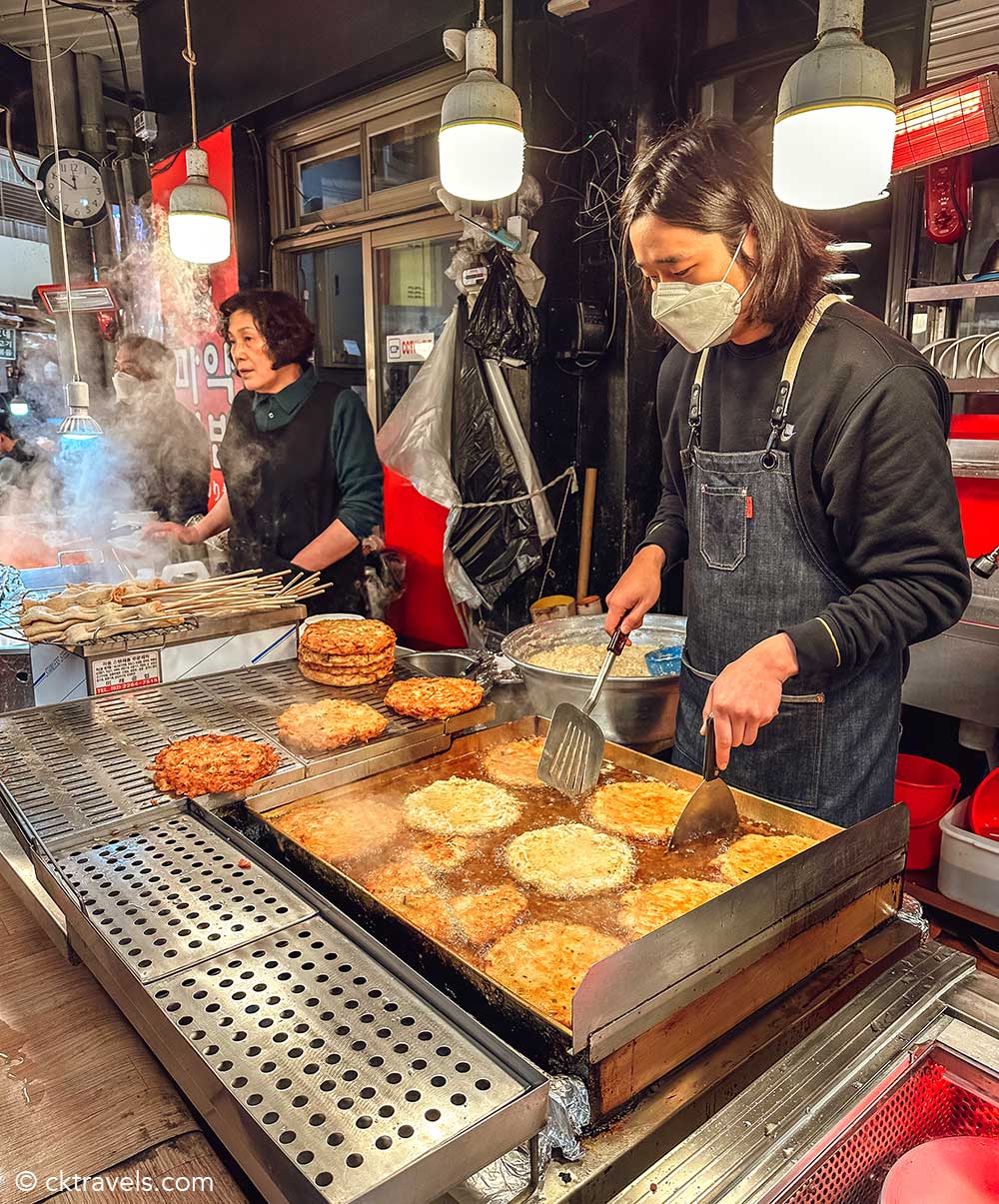
The final touch is a sprinkle of seasonings like garlic or pepper before being boiled in hot oil.
Greasy as but pretty tasty, expect to pay 5,000 Korean Won for a huge Korean street food pancake (you can sometimes buy smaller ones too).
Love Korean food? Check out our South Korea food and drink hub with lots of gourmet guides >
10. Korean Street Toast (Gilgeori Toast)
Korean street toast is a hugely popular and iconic breakfast street food (or daytime snack). It is a sweet and savoury sandwich made from thick slices of buttered bread which are toasted on a grill, and then filled with meat, omelette, cheese, ketchup, sugar and crunchy shredded cabbage.
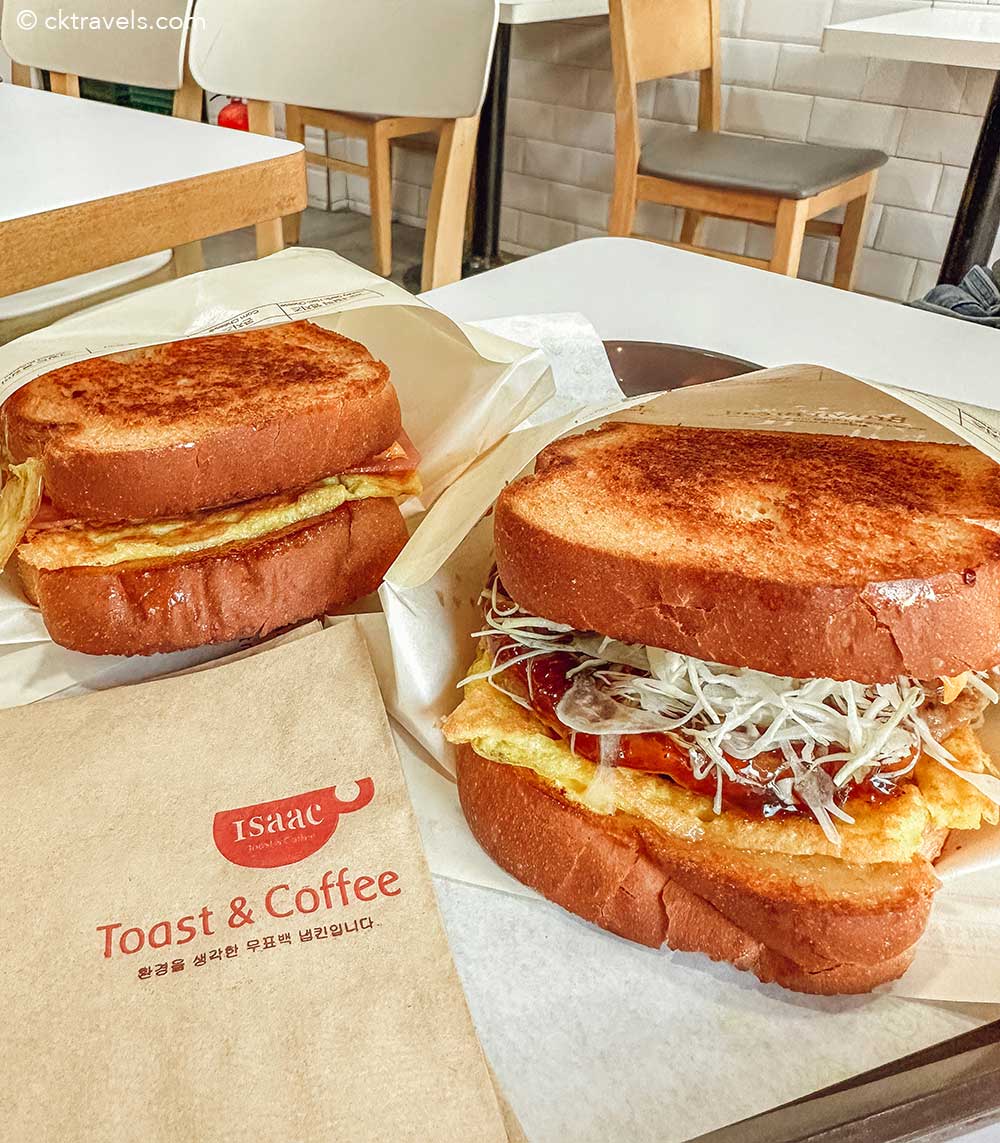
Gilgeori Toast can be found at many street food vendor stalls, but we tried several varieties from a chain street food stall called Isaac Toast which we highly recommend.
Read more in our guide to Isaac Toast >
11. Fish Shaped Pastry Waffles (Bungeoppang)
Hello little fishy! Next time you are in South Korea, chow down on these carp like waffles, shaped in a piscine shape (but not containing any actual seafood or fish).
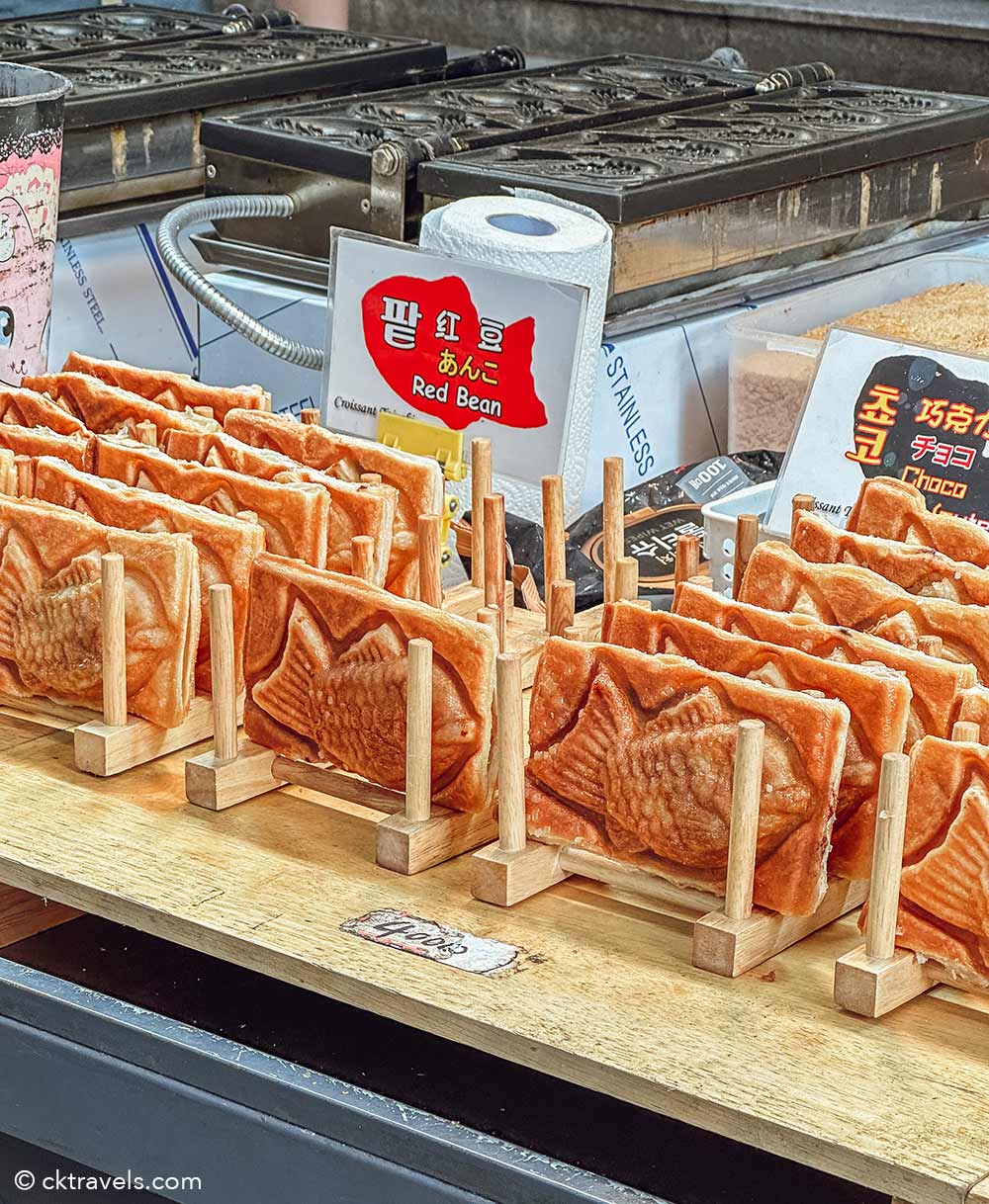
A Korean take on a Japanese classic street-food, this is a fish shaped filled croissant packed full of sweetness, with fillings such as red bean, chocolate, sweet potato or cheese. Bungeoppang are very popular as a winter dessert and are very filling.
You might like: Drinking and Eating through the Alleys of Seoul tour >
11. Korean Blood Sausage (Ssondae / Ssundae)
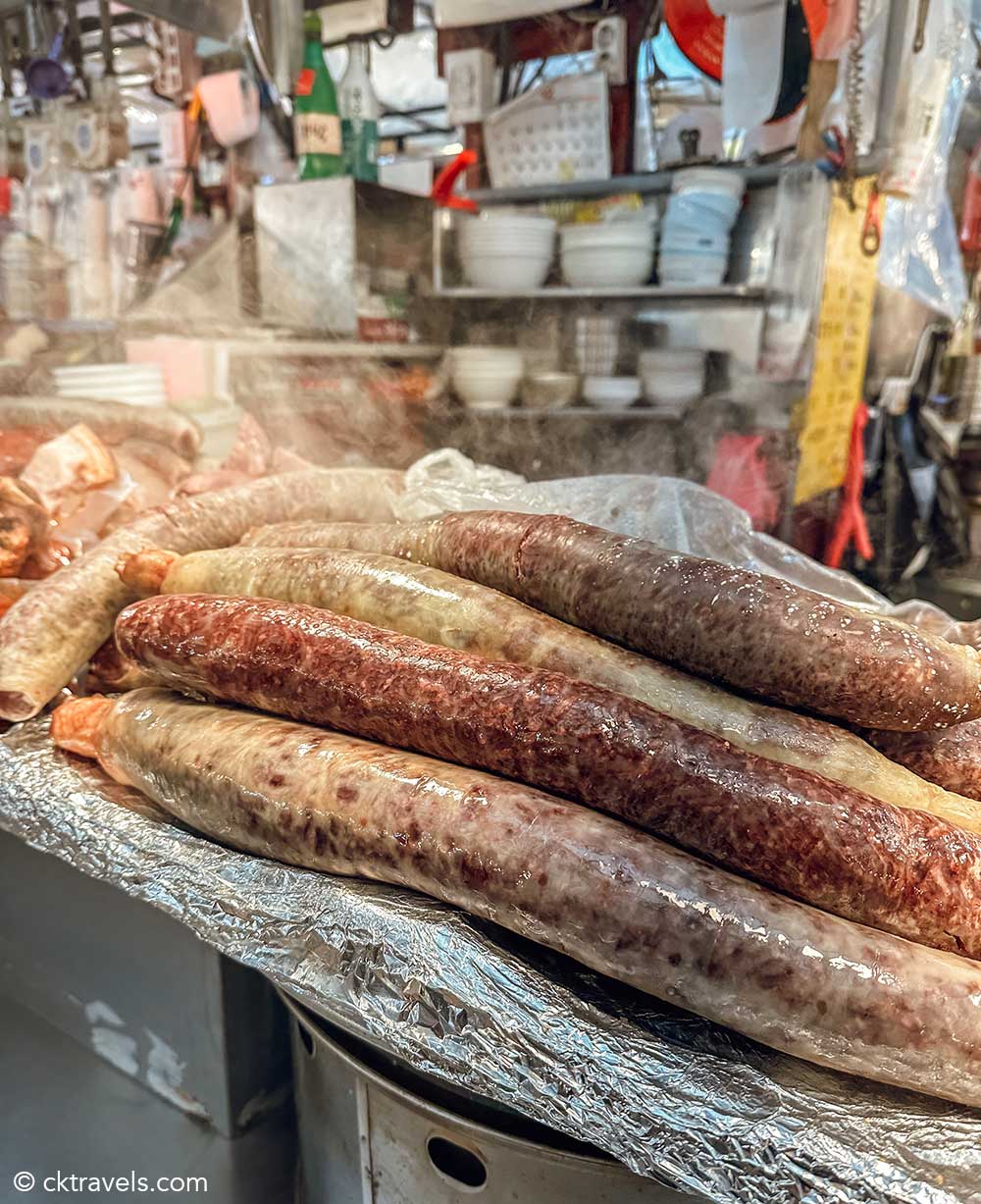
Ssondae / Korean blood sausage is usually made from pig blood and noodles / rice served in a cow or pig intestine, making for a slightly chewy texture.
They are generally sliced into small pieces before serving. This is often served as a combo with the above mentioned Tteokbokki rice cakes.
You might like – 101 things to do in Seoul >
12. Deep Fried Vegetables, Meats and Seafood (Twigim)
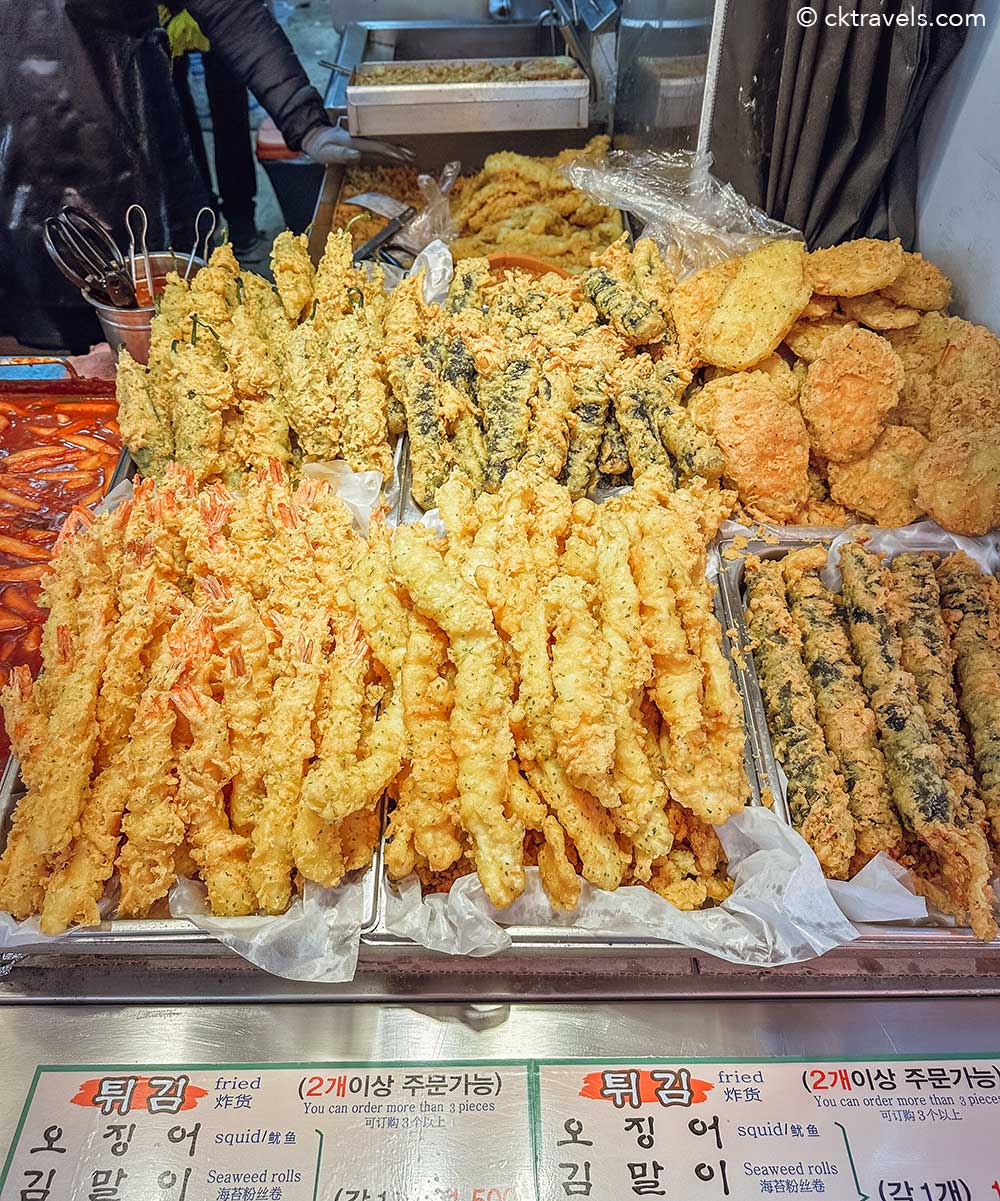
Twigim is the Korean version of Japanese tempura, and are a popular greasy treat! Vegetables, seafoods or meats are deep fried in a light, crispy batter and served with a soy sauce or spicy dip.
This Korean street food is often found at night markets and is great when paired with tteokbokki!
13. Korean Pancakes (Buchimgae)
Buchimgae is a crisp, hearty Korean savoury pancake, made by frying a thick batter into a thin flat pancake shaped fritter.
There are a few different buchimgae types such as green onion, chives or kimchi. The pancake is cut up before being served with a dipping sauce.
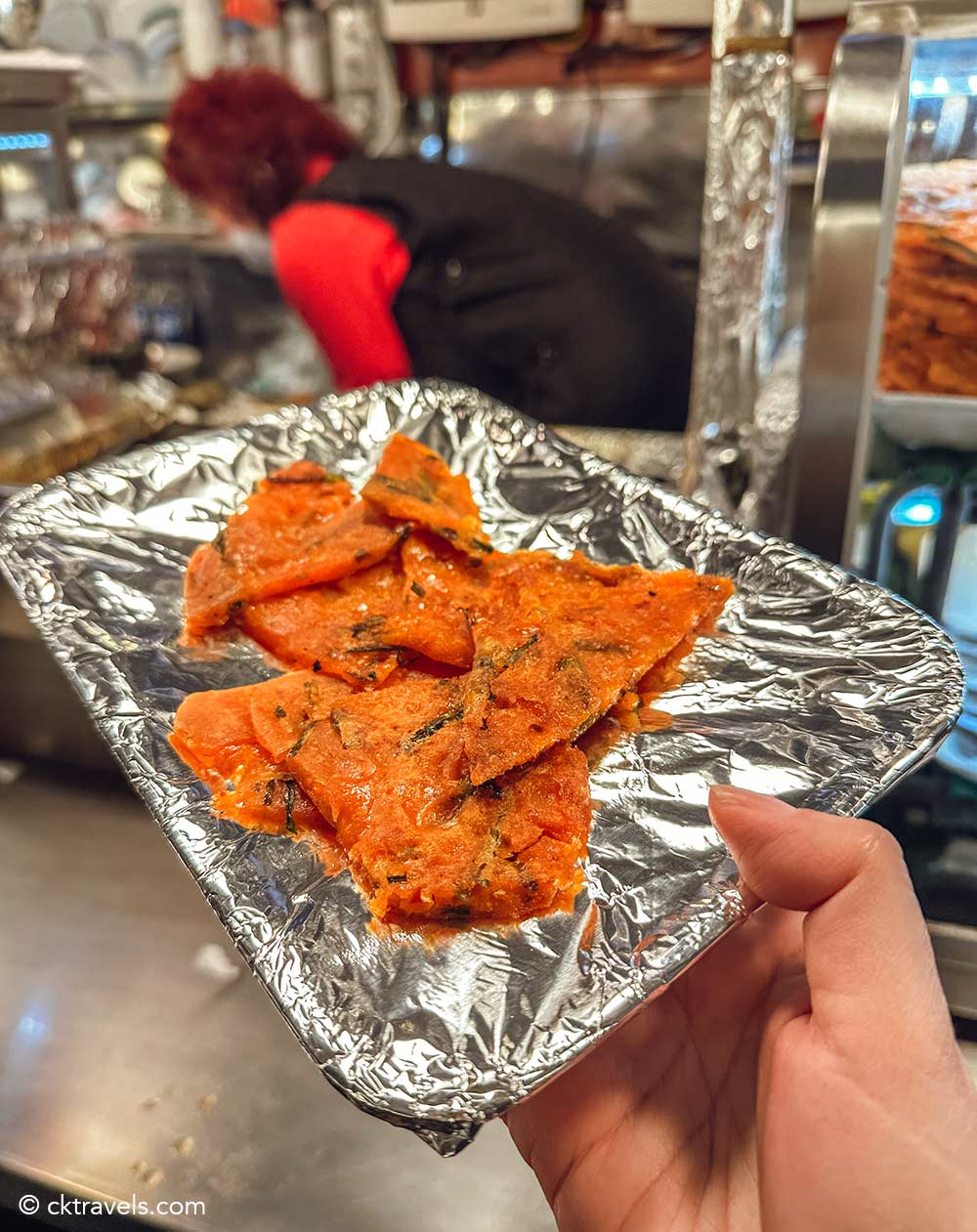
We tried various versions of Korean pancakes and found them a bit hit and miss – if you can get fresh ones, go for that as those buchimgae that seem to be reheated often tasted quite greasy and lacklustre.
14. Twisted Donuts / doughnuts (Kkwabaegi)
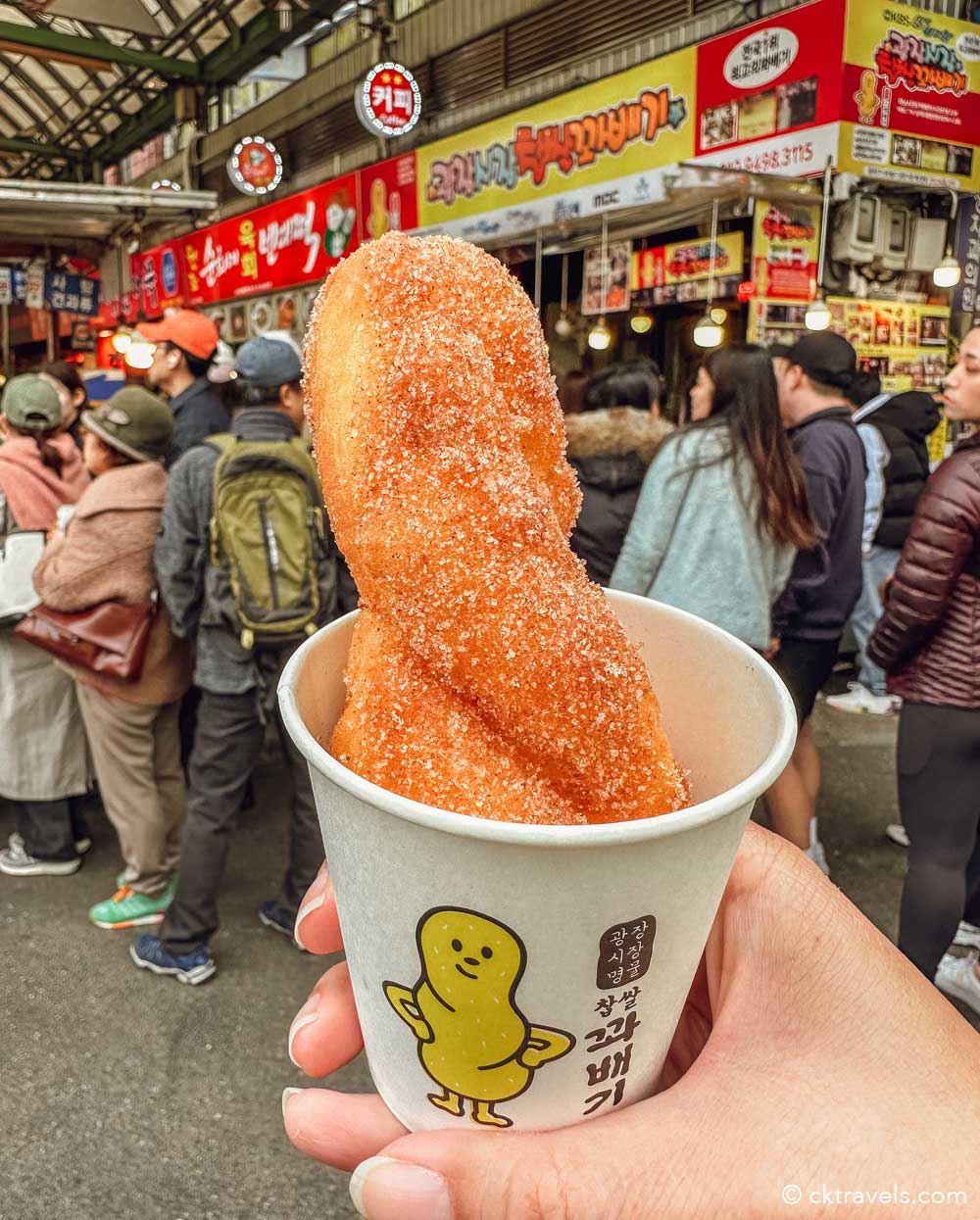
Classic Korean doughnuts twisted are popular in night markets, street food stalls and bakeries across South Korea. Candy-floss like inside (soft, sweet and fluffy) with a golden outside, these sweet treats are served with a sugar glaze. ‘Donut’ visit South Korea without trying Kkwabaegi.
You might like: Traditional Cooking Experience in Korean Style House in Seoul >
15. Chicken Feet (Dakbal)
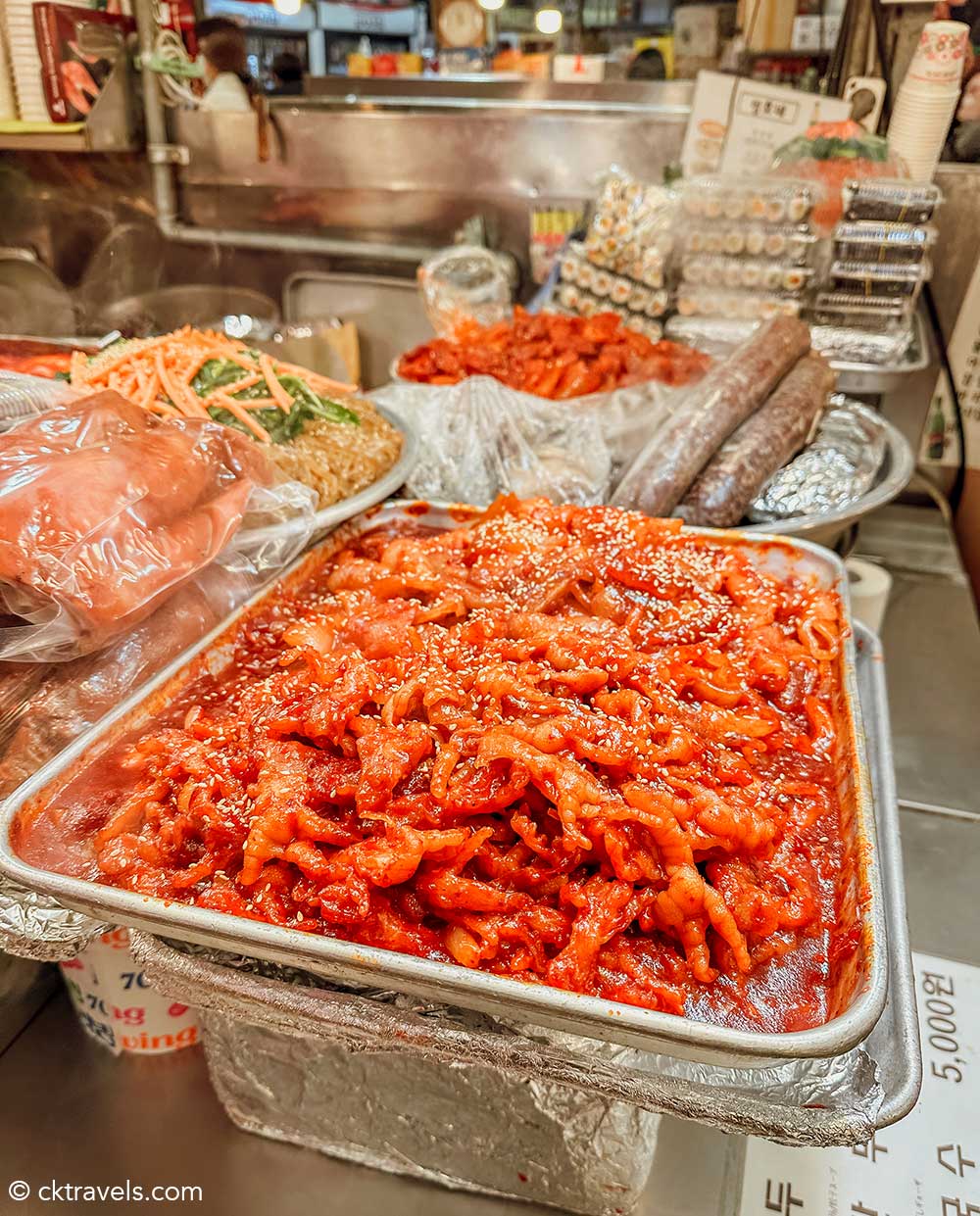
Marinated chicken feet are incredibly popular and often a cheaper alternative to the traditional Korean fried chicken (the latter is usually made from chicken breast or chicken thigh).
As well as being popular at street food markets and night markets, dakbal is popular as a deep fried snack food in pubs and bars.
You might like: things to do in Gangnam, Seoul
16. Mayak Kimbap / Ggoma Gimbap
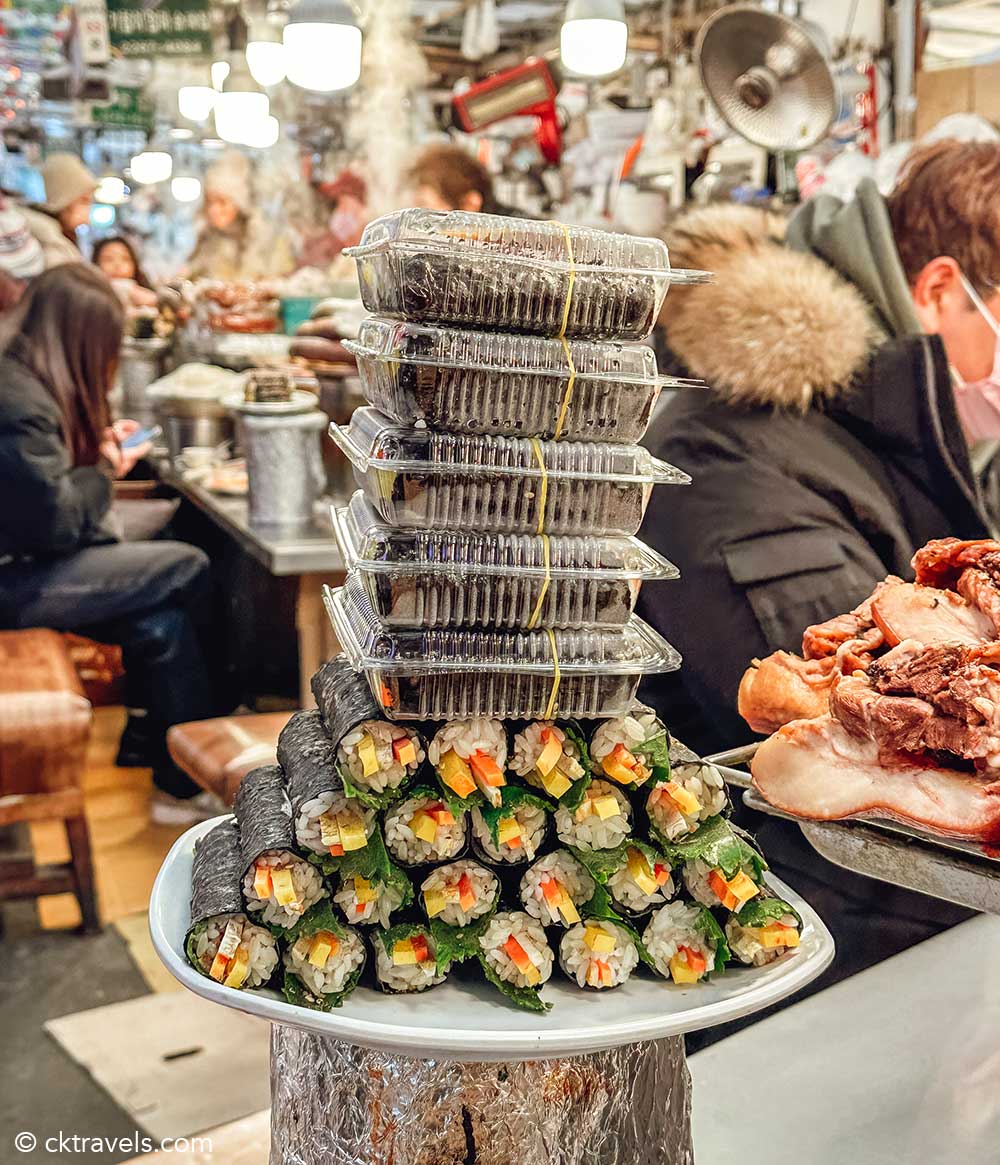
Similar to sushi rolls you’d get in Japan, Mayak Kimbaps are widely available and pretty cheap .
‘Mayak’ in Korean is slang for ‘drugs’, so highly addictive are these savoury snack rolls! Versions differ depending on the region but most mayak kimbaps contain pickled radish, carrots and greens.
17. Egg Bread (Gyeran-ppang)
This is one of our favourite cheap eats in terms of Korean street-food (some would say ‘eggs-cellent street food in South Korea; sorry not sorry…) – Gyeran-ppang; essentially Korean sweet bread (it uses a vanilla essence) with an egg cracked and baked on top.
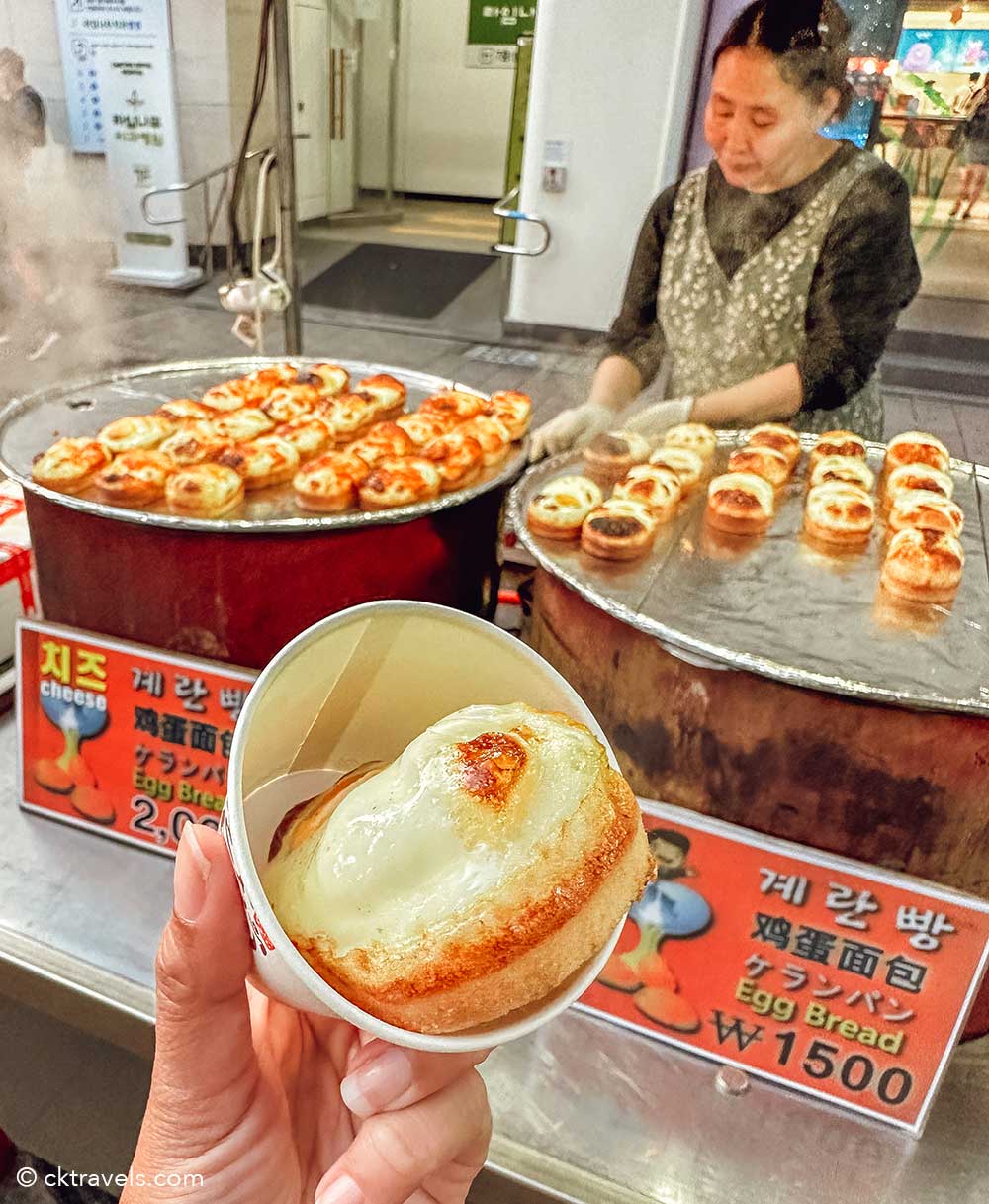
Definitely one of the more frequent street food stalls you’ll see (especially in Seoul and at Myeongdong Night Market), as gyeran-ppang is fairly easy to make, has few ingredients and best of all, tastes delicious.
Expect to pay around 1,500 Won to 2,000 Won per piece of egg-bread in South Korea.
18. Pan-fried Rice Cake (Bukkumi)
Another South Korean pancake variant, bukkumi is a pan-fried tteok made with glutinous rice flour that comes in a multitude of flavours like pumpkin or sweet potato.
19. Korean Honeycomb Candy (Dalgona or Ppopgi)
Popularised overseas by its appearance in Netflix’s global streaming hit Squid Game, many street food vendors in South Korea now sell the honeycomb biscuit (dalgona) with big placards showing the Squid Game characters (hopefully the Netflix copyright team aren’t skulking in the shadows).
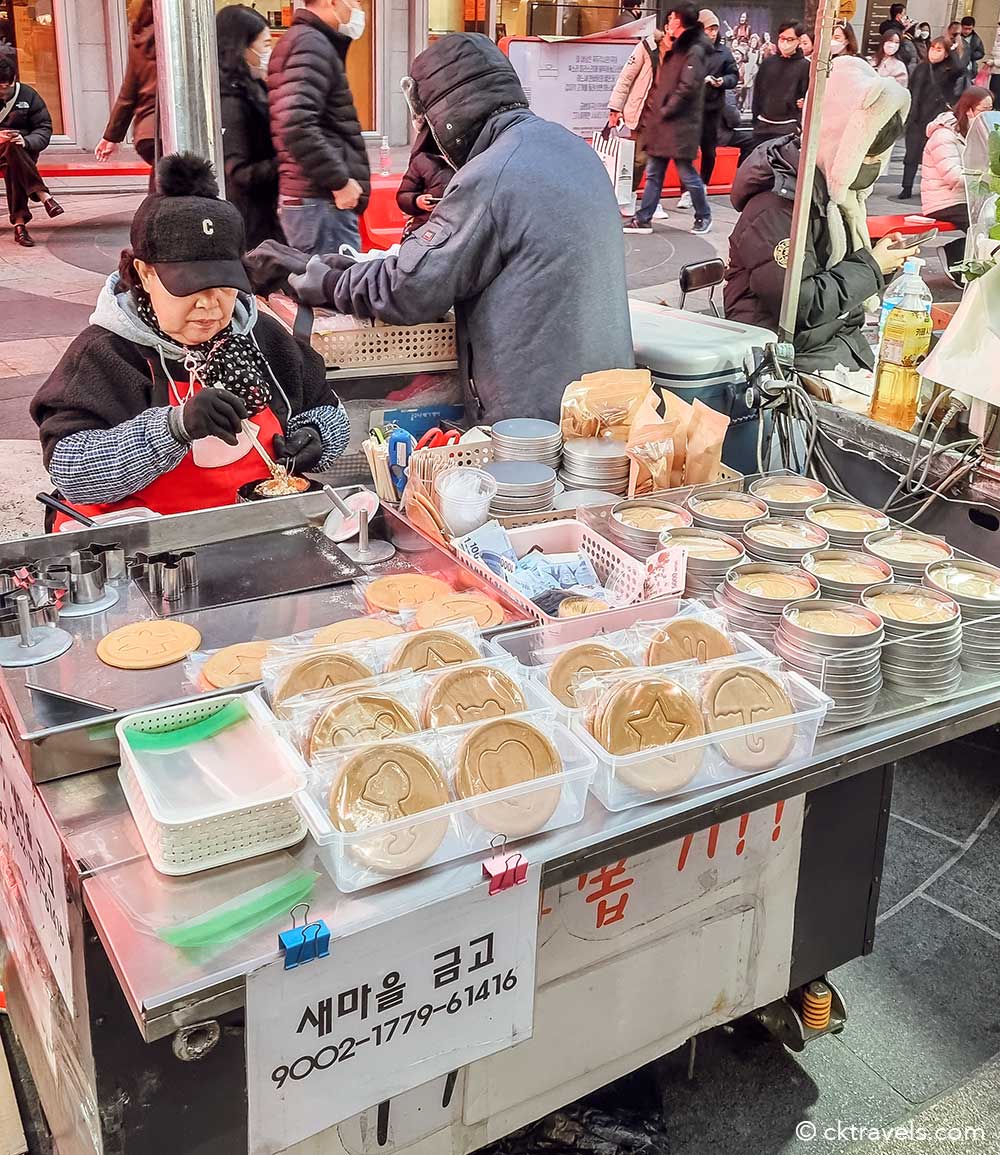
Dalgona is made with sugar and baking soda. As in the Netflix show Squid Game, many street food vendors sell versions with shapes ready to be carved out by you (if you dare!).
You can also buy Squid Game style dalgona making tools on Amazon >
20. Korean Fish Cake (Eomuk)
Korean fish cakes are a very popular Korean street food snack during the winter months and are made from minced white fish and flour.
They are available in different shapes (long or zigzagged) and the most common way to eat them is on a skewer which has been boiled in a fish broth.
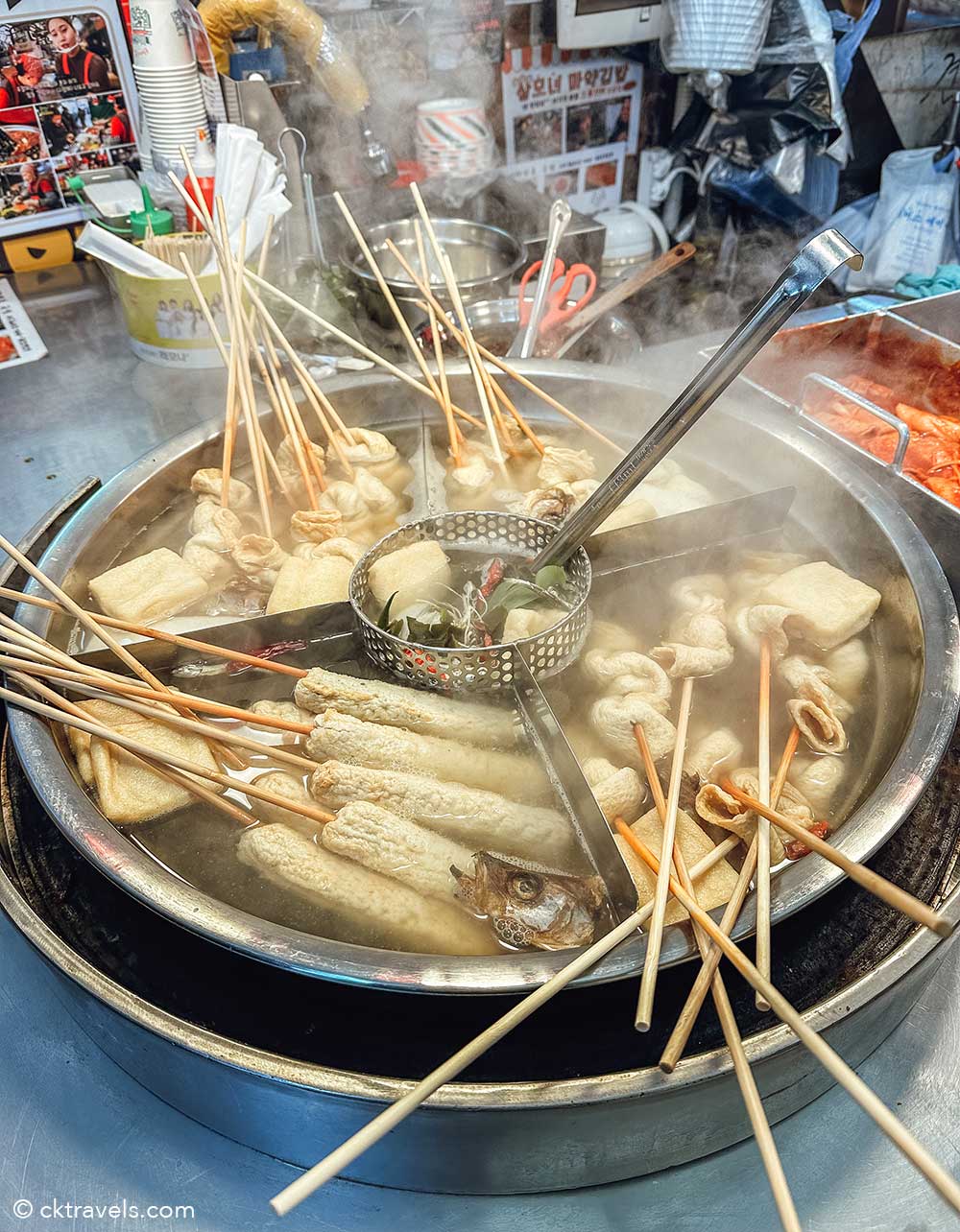
Street vendors will sell the skewered fish cake with some of the hot broth inside a paper cup for you to take away and eat. You can also find street food vendors selling tteokbokki and eomuk together on a stick!
One of the most famous Korean fish cake shops is Busan’s Goraesa Fishcakes which has four branches including BIFF Square and Haeundae – they are popular for their fine fish style cake (eomuk) since the early 1960s.
21. Tornado Potato / Twisted Potatoes / Hweori Gamja
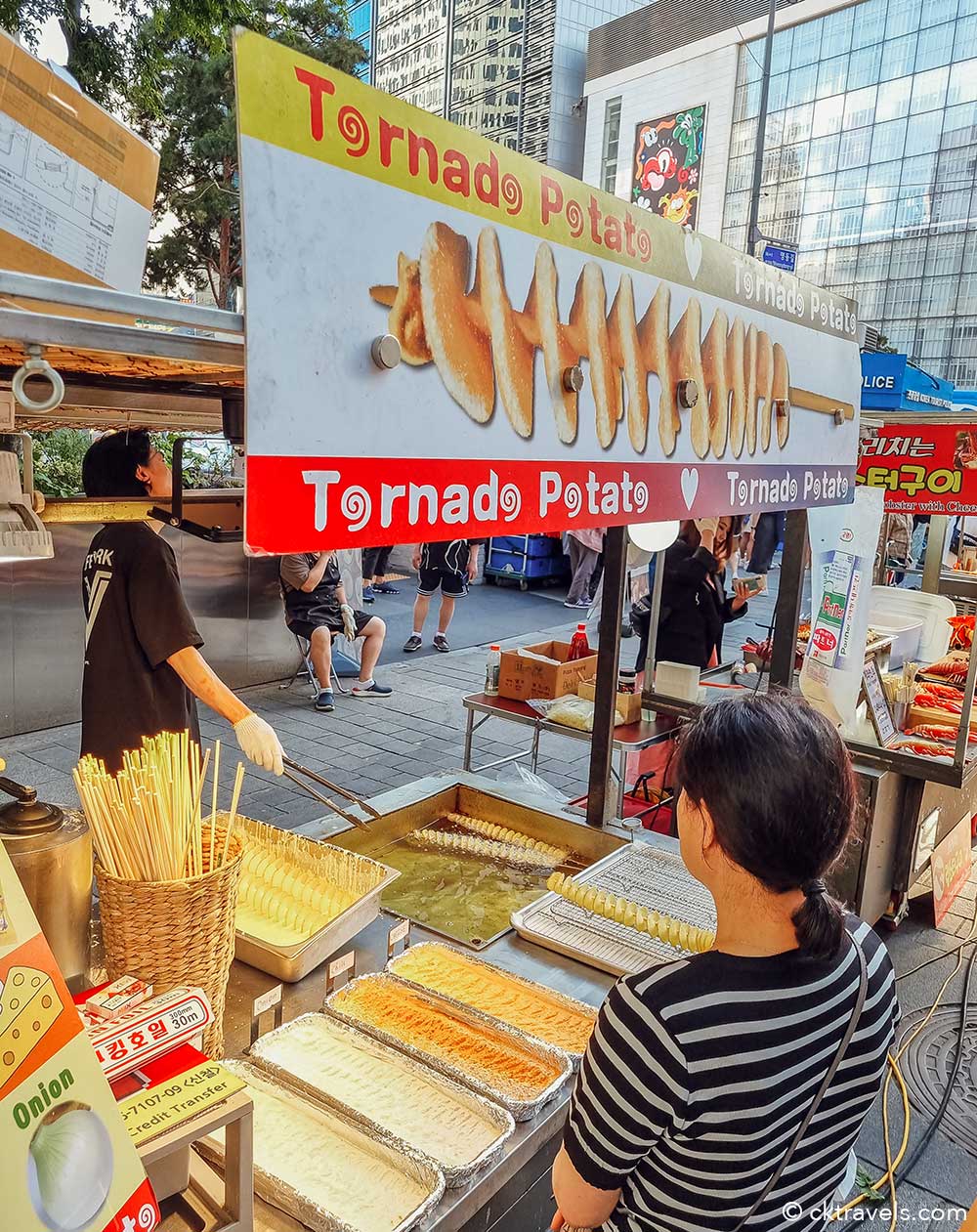
Street-food originally from Korea but now found worldwide, Tornado Potatoes (known locally as Hweori Gamja) are basically spuds cut into a thin spiral shape and then deep fat fried.
Not exactly healthy but tasty, yes. Various Tornado Potato flavours are available including spicy pepper or cheese.
You might like – Our guide to the best day trips from Seoul including DMZ tours
22. Korean Taffy-Ta-Ra
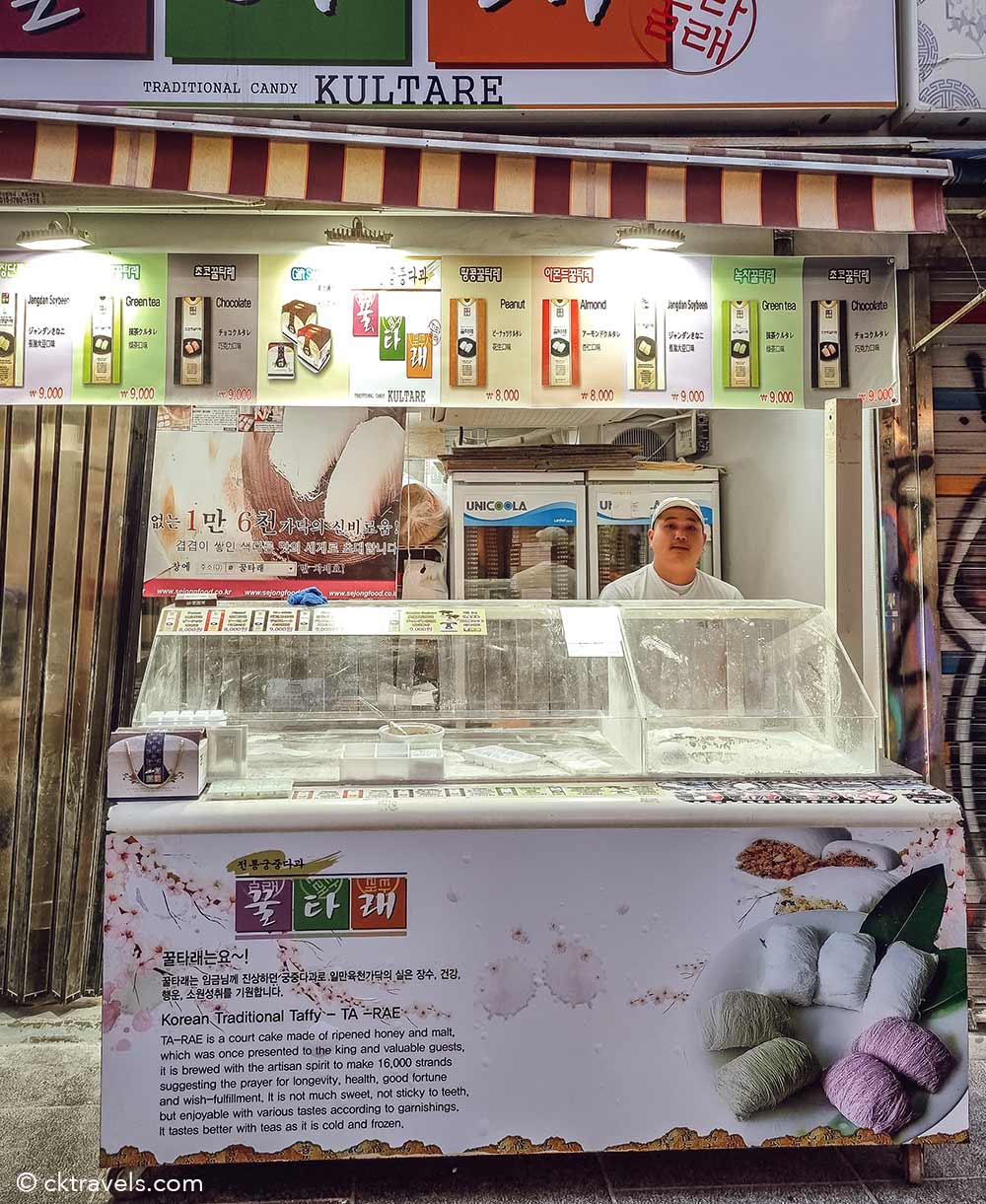
Also known as Korean court cake or Dragon’s Beard candy, Taffy Ta Ra is made of thousands of strands of ripened honey and malt (which was once presented to the King and his important guests hence ‘court cake’).
It is very popular with children and the staff on the stall often tell tall tales of dragons when they make the candy-floss treat – one of the most famous taffy-ta-ra stalls can be found in Insadong, Seoul.
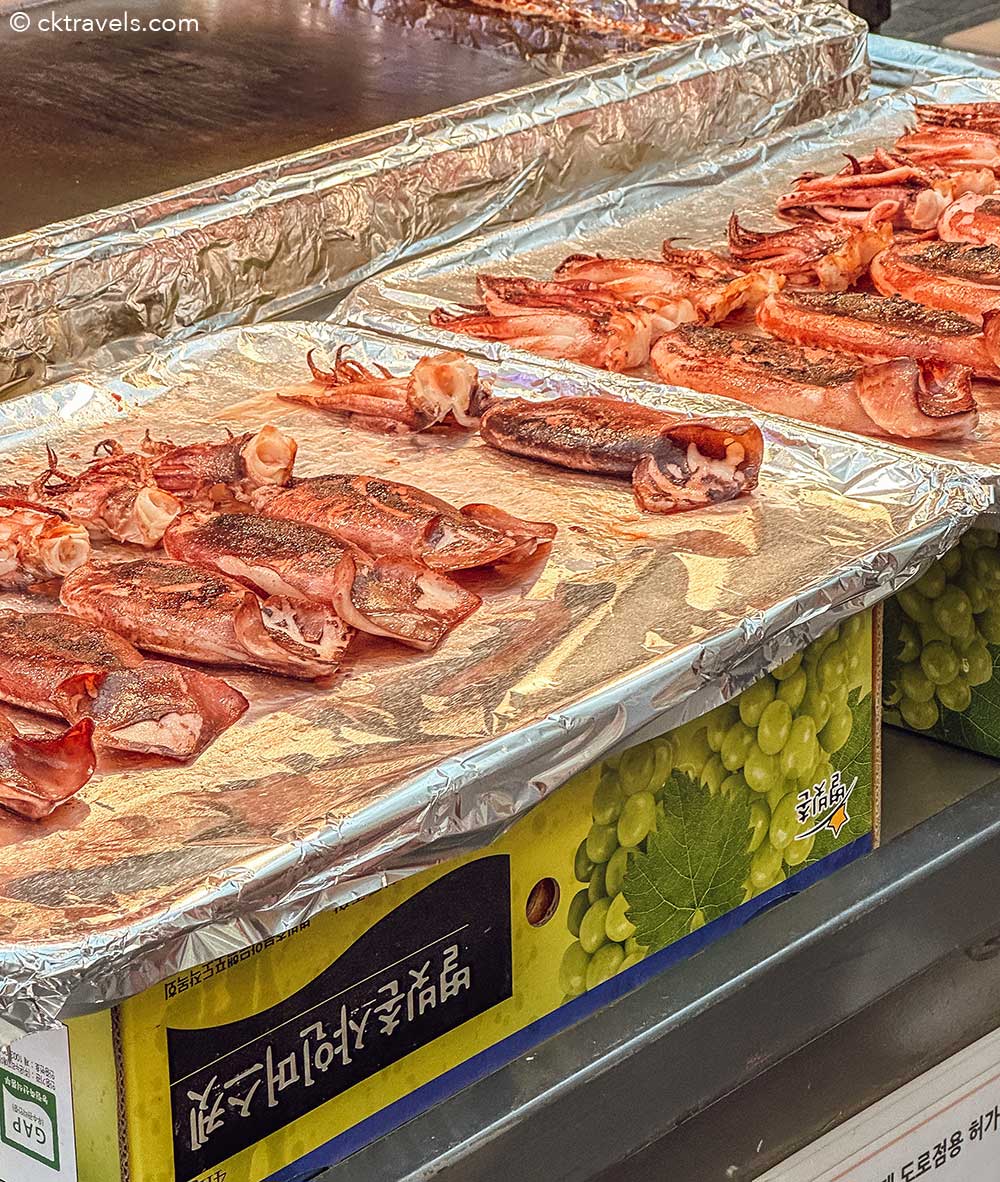
23. Grilled Squid /’Ojingeo Gui’
One of the most popular Korean street foods available at most South Korean night markets is grilled squid – often served with a spicy coating / sauce.
Widely available on BBQ street food stalls – just follow your nose (it is one of the more pungent street foods in Korea).
You might like – Our guide to the 5 best, unusual & beautiful Korean Starbucks >
24. Walnut Cookies (Hodugwaja)
We’re ‘nuts’ about this Korean street food; warm and wonderful walnut cookies – made from cake batter mixed with chopped walnuts, these Hodugwaja street-food stalls can be seen (and smelt!) all over South Korea, particularly in winter time.
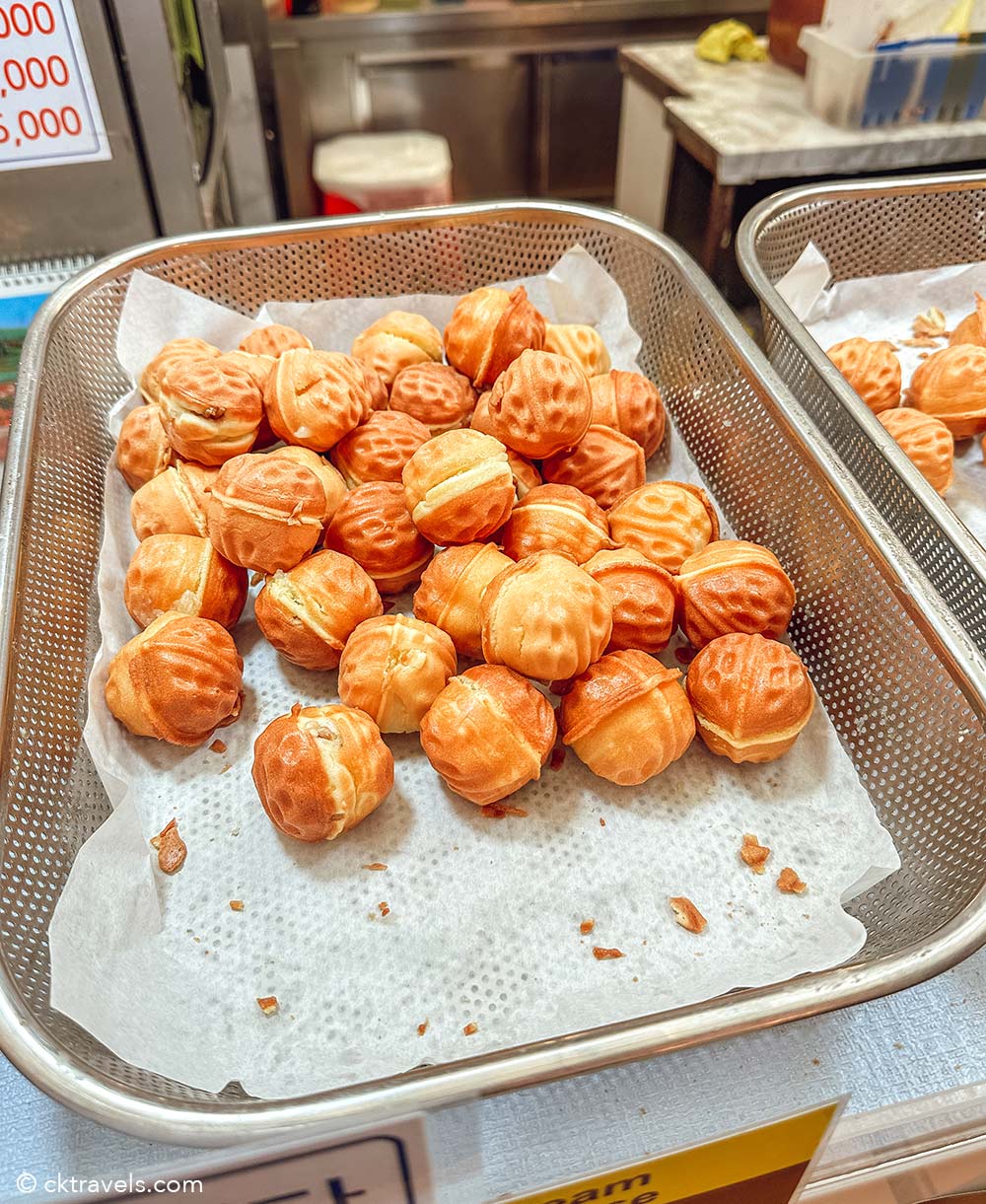
These cute cookies are baked in walnut shaped baking trays so that the finished Hodugwaja is even shaped like a walnut. Several Hodugwaja flavors are usually available including custard or red bean.
You might like – 50+ things to do in Seoul with kids >
25. Nabjak Mandu (Daegu)
One of 10 ‘listed’ foods that are exclusive to Daegu, nabjak mandu are flat dumplings, fried in lots of oil and filled with glass noodles and chives. You can also top them with a special soy sauce and spring / green onions.
We found several Nabjak Mandu stalls at Seomun Market and paid 3,000 won for a small portion. We ate ours cooked but many locals were buying uncooked dumplings to heat and eat at home.

You might like – 15+ things to do in Daegu >
26. Korean Cream Bread (Ppang)
There are several types of popular cream bread (ppang) in Korea including CU convenience store’s Yonsai cream milk bread which became an instant hit on social media.
Whilst possibly not the most healthy snack, milk cream bread in South Korea is here to stay.

To bling your cream bread, head to Abebe Bakery for cream filled donuts (cream bread) – Seoul’s hottest dessert right now, with a new bakery location near the famous Gwangjang Market.
With over 40 different flavors of cream filled donut from Jeju Orange and Matcha, join the BIG queue outside Abebe Bakery for one of Seoul tastiest sweet treats. Read our guide >

You might like – 40 things to do in Seoul at night >
27. Instant Noodles / Ramyun Noodles
OK, so this isn’t the easiest street food to eat on the go but we can assure you we’ve seen ramyun noodle stalls at markets such as Gwangjang Market.
Ramen noodles have dedicated sections in South Korean convenience stores like CU and 7-Eleven – you can usually find a dedicated aisle chock full of choice ramen flavours like sriracha, curry, seafood and fried chicken.

Even better, most convenience stores in South Korea include either a hot water vat / urn or plumbed system where you pour boiling hot water on your noodles and then slurp away in the store or on the go.
Prices start from 1,300 Won for small packets of instant noodles. Popular brands include Nongshim (농심) and Samyang Foods (삼양식품).

You might like – 35+ food and drink items to buy in CU Convenience stores >
28. Peanut Cake
Now this was a tasty discovery in Daegu – 20 pieces of Seomun peanut cake for only 3,000 Won.

There were several Daegu peanut cake stalls in Seomun Market but we just went to one of the busy ones with lots of locals queuing up.
Served warm, the peanut cakes are bite-sized, very cheap and delicious but also quite dry so you might want to have a drink on standby.
29. Japchae
Korea’s famous glass noodle dish which is available in many markets and many different forms – it usually has lots of sesame seeds, vegetables and sometimes meat.

One of the best japchae experiences we had was at Gwangjang Market’s Hosunseng 호선생전 광장시장 restaurant – we ate spicy japchae noodles wrapped in pork and seaweed served with Maekgolli.

You might like – Our guide to Korea’s Grandma’s beer bars 역전할머니맥주 >
30. Octopus
For whatever reason, the preference in many places is to eat octopus fresh and ‘live’, straight from the tank (it is quite common to see them squirting water as you walk by) – expect to pay from at least 30,000 Won per portion.

One of the best places to eat octopus on the go in South Korea is Busan’s Haeundae Traditional Market.
If you want octopus but would rather it was already dead (our preference), there are a couple of grilled octopus stalls at the market as well.
You might like – Our guide to Haeundae Traditional Market >
31. Ginseng Tempura
If you want an energy boost (because Gwangjang Market can be tiring when busy), grab some deep-fried ginseng in tempura form.
Costing 10,000 Won, Gwangjang Market ginseng goods often have a small queue so get in quick!

Best Korean street food – Jeju Island edition
If you are lucky enough to visit Jeju Island, be sure to try these local street food dishes – the next three dishes all go really well with fresh Jeju hallabong tangerine juice.
32. Jeju Island Black Pork
Jeju Island’s most famous food, Jeju’s Black Pork dishes can be found at many stalls at Dongmun Night Market and usually flamed grilled.
Jeju Island black pork is said to have a flavourful and unique taste although the pork itself isn’t black in colour; it refers to the black hair of the Jeju Island pigs that is bred to produce this dish.

33. Korean style blow-torched scotch egg
This is the Dongmun Market dish we tried first – essentially a boiled egg wrapped in Jeju black pork then covered in bacon and flame torched! We had ours with a garlic sauce – it was soo good.

34. Jeonbuk Ttukbaegi AKA Abalone Hotpot
A seafood hot pot served up with abalone; bubbling hot when given to you, you may need to wait a moment for your Jeonbuk Ttukbaegi to cool down before slurping it.
You might like – Our guide to Jeju Island’s Dongmun Night Market >
Our final Korean street food…
35. Skewered Meats
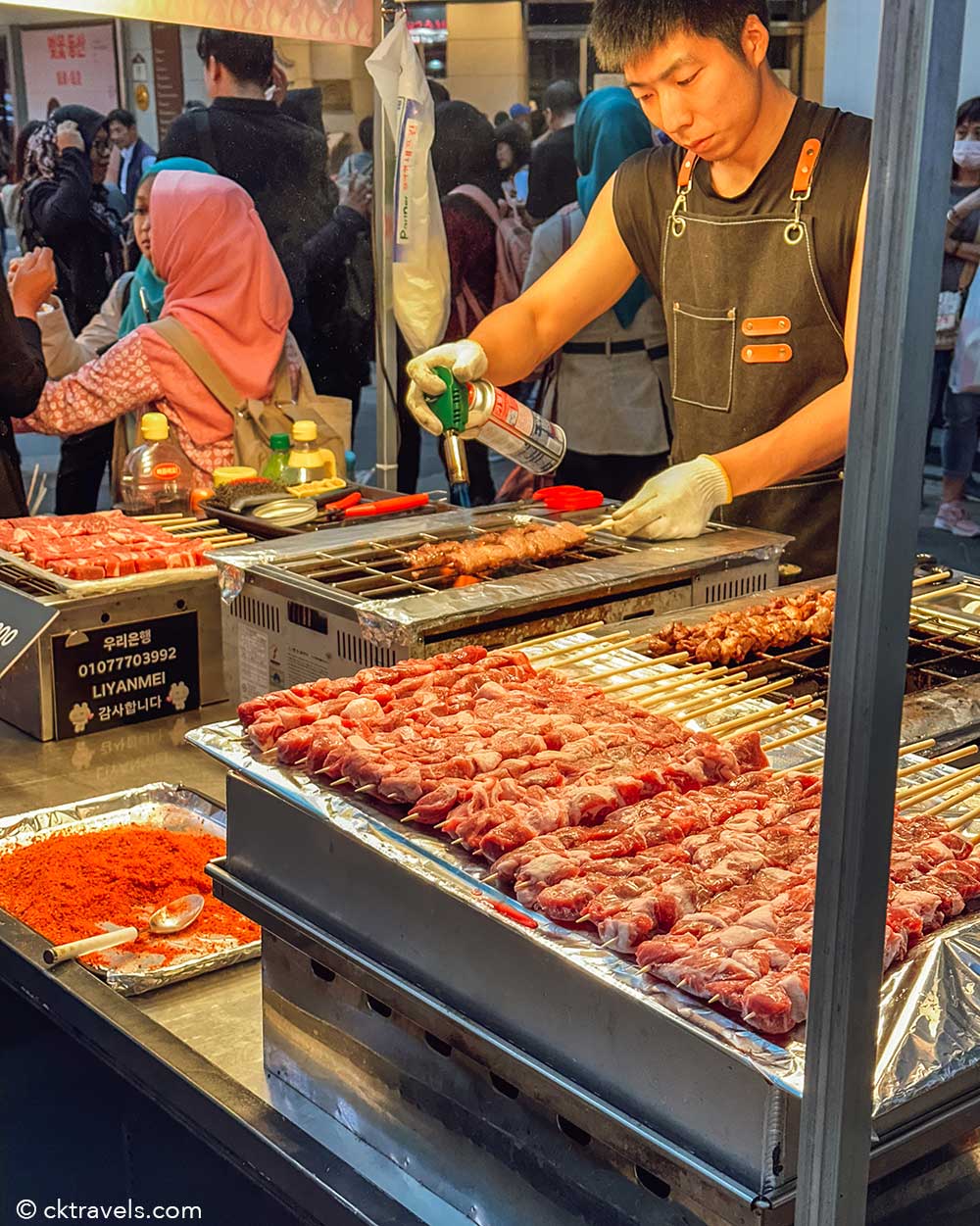
Pleased to ‘meat’ you – meat always tastes better on skewers (it is scientifically proven – probably), especially when it has been flame-grilled.
They are always fun to eat at, especially when the stall holders crank out the blow torch – quite the spectacle and smoky smell.
Skewered lamb skewers, salted chicken skewers and blow torched beef skewers are quite a common street-food in South Korea.
Found this guide helpful?
Did you enjoy our best Korean street food in South Korea guide blog post? Let us know in the comments or by sharing it on social media.
You can follow South Korea Hallyu on:
Instagram
Facebook group
Facebook page
TikTok
